Real-Time Database: Synchronize Application Data Instantly
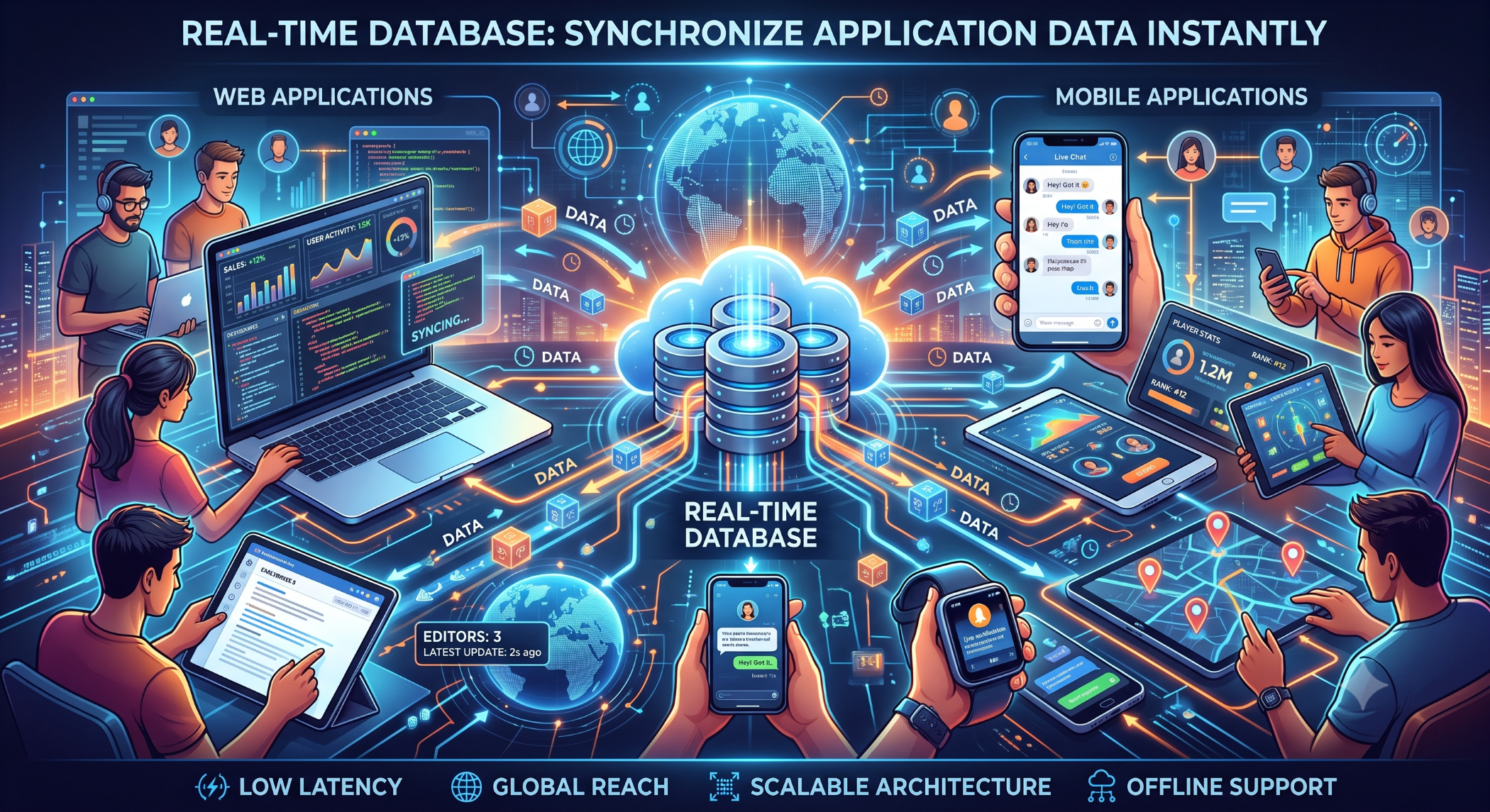
Modern applications often need information to appear across multiple users and devices as soon as it changes. Real-time databases help address this requirement by synchronizing application data with connected clients, reducing the need for users to repeatedly refresh the application.
They are particularly useful for applications where data changes frequently and users need to see those changes quickly.
What Is a Real-Time Database?
A real-time database is a database system designed to synchronize data changes with connected clients with minimal delay.
A simplified architecture looks like:
User A
↓
Application
↓
Real-Time Database
↓
User B / User C
When data changes, connected applications can receive the updated information according to the database and client architecture.
How Does a Real-Time Database Work?
A typical real-time database implementation includes a client application, backend or database service, and synchronization mechanism.
For example:
Data Change
↓
Database Update
↓
Change Detection
↓
Connected Clients
↓
Updated Interface
This allows users to see changes without manually requesting the latest data every time.
Real-Time Database vs Traditional Database
A traditional database can store and retrieve application data efficiently, but applications typically request updated information when needed.
A real-time database adds a synchronization layer so changes can be pushed or propagated to connected clients.
For example, in a standard application:
User → Request → Server → Database → Response
A real-time application may work more like:
User A → Database Update
↓
Real-Time Event
↙ ↘
User B User C
The right approach depends on how quickly data needs to be synchronized.
Common Uses of Real-Time Databases
Chat Applications
New messages can appear immediately for participants in a conversation.
Live Tracking
Delivery and logistics applications can synchronize location, status, and other operational information.
Collaborative Applications
Multiple users can see updates made by other users while working on shared data.
Live Dashboards
Business dashboards can display changing metrics and operational events as data becomes available.
Multiplayer Games
Games can use synchronized state for player actions, scores, and other game information.
Firebase Real-Time Database
Firebase Realtime Database is a cloud-hosted NoSQL database that synchronizes data in real time to connected applications.
It can be useful for applications that require real-time synchronization with relatively straightforward data structures.
Firebase also provides Cloud Firestore, another database option designed for application development with different data modeling and querying capabilities.
Choosing between the two should depend on the application's data model, query requirements, synchronization needs, expected scale, and long-term architecture.
Benefits of Real-Time Databases
Faster User Updates
Users can receive changes without repeatedly refreshing the application.
Better Collaboration
Shared information can stay synchronized across multiple users and devices.
Reduced Polling
Applications may not need to continuously request the server to check whether data has changed.
Better User Experience
Real-time updates can make applications feel more responsive and interactive.
Challenges of Real-Time Databases
Real-time synchronization also introduces additional technical considerations.
Connection Management
Applications may need to maintain many simultaneous connections, requiring appropriate infrastructure and monitoring.
Data Consistency
When multiple users modify the same information, applications need clear rules for handling conflicting changes.
Security
Real-time access must be controlled so users can only read or modify data they are authorized to access.
Cost and Scalability
Database reads, writes, storage, bandwidth, and simultaneous connections can affect operating costs as usage increases.
Real-Time Database Security
Security should be designed from the beginning.
Use authentication, authorization rules, secure communication, and appropriate access controls.
Do not expose sensitive application data simply because clients need real-time access. Each user should receive only the information permitted by the application's security model.
Real-Time Database and APIs
Real-time databases do not necessarily replace traditional APIs.
An application may use REST or other APIs for operations such as authentication, reporting, and administrative functions while using real-time synchronization for live updates.
For example:
REST API → Standard Application Operations
Real-Time Layer → Live Data Updates
Using different communication mechanisms for different requirements can produce a more practical architecture.
Best Practices
Define which data actually needs real-time synchronization. Not every piece of application data needs to be updated instantly.
Design the data structure carefully, secure read and write access, handle network interruptions and reconnections, and monitor synchronization performance.
Test the application under realistic numbers of connected users and concurrent updates before production deployment.
Real-Time Database Solutions at Solace Infotech
Solace Infotech works across web applications, mobile apps, APIs, cloud technologies, Firebase, databases, and real-time application development.
A real-time database can be integrated into customized business solutions such as communication platforms, dashboards, tracking systems, customer applications, and other applications where timely data synchronization is important.
Conclusion
A real-time database can help applications deliver fast data synchronization, responsive interfaces, and connected user experiences.
From messaging and live tracking to dashboards and collaborative applications, real-time data can provide significant business value when information needs to stay current.
The right solution depends on the application's data model, synchronization requirements, security, expected user volume, and infrastructure strategy. A carefully designed real-time architecture can provide responsive experiences while remaining scalable and maintainable.