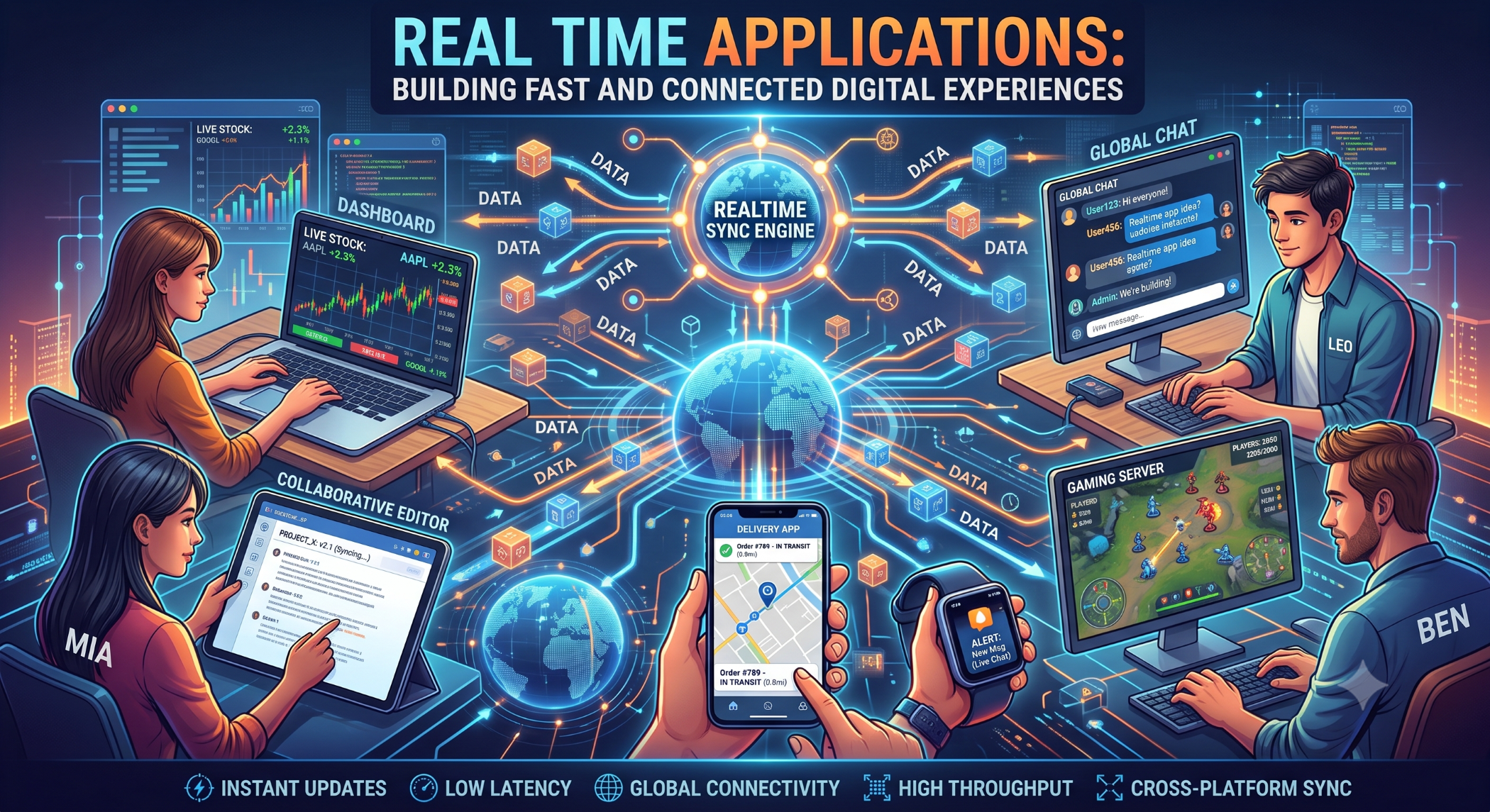
Realtime Applications: Building Fast and Connected Digital Experiences
Modern users expect applications to respond quickly and keep information up to date. Realtime applications are designed to deliver changes with minimal delay, allowing users to see new information as it becomes available.
Realtime functionality is useful across communication, tracking, collaboration, dashboards, notifications, and business applications.
What Is a Realtime Application?
A realtime application is a system that can communicate changes to users or connected systems with very little delay.
A traditional application may require the user to refresh a page to retrieve updated information. A realtime application can automatically deliver the latest information.
A simplified flow is:
Event
↓
Backend
↓
Realtime Communication
↓
Connected Client
↓
Updated Interface
How Realtime Communication Works
Different technologies can be used depending on the application.
WebSockets provide persistent two-way communication between clients and servers.
Server-Sent Events (SSE) allow servers to push updates to connected web clients.
Message brokers can distribute events between backend services.
Push notification services can notify users when an application is not actively open.
The appropriate technology depends on the required latency, scale, communication pattern, and platform.
Common Realtime Use Cases
Instant Messaging
Chat applications need messages to appear quickly without requiring users to refresh the conversation.
Live Tracking
Logistics and delivery platforms can provide current status, location, and estimated arrival information.
Live Dashboards
Business dashboards can display continuously changing operational or performance information.
Collaboration
Collaborative tools can synchronize changes across multiple users working on the same information.
Notifications
Applications can automatically notify users about events such as new messages, completed orders, or appointment reminders.
Realtime Data Synchronization
Many realtime applications need information to remain synchronized across several clients.
For example:
User A Updates Data
↓
Backend
↓
Database
↓
Realtime Event
↙ ↘
User B User C
The application needs clear rules for how updates are stored, distributed, and handled when multiple users modify the same data.
Realtime Applications and APIs
Realtime communication does not necessarily replace traditional APIs.
A modern application can use REST APIs for standard operations and WebSockets or another realtime mechanism for live updates.
For example:
REST API
↓
Login / CRUD / Reports
Realtime Layer
↓
Messages / Status / Live Updates
Using the right communication method for each requirement can result in a more efficient architecture.
Realtime Mobile Applications
Mobile applications can combine realtime communication with push notifications.
For example, a delivery application may show live driver updates while the app is open and send a push notification when the user is not actively using it.
Mobile applications also need to handle intermittent connectivity and reconnection gracefully.
Challenges in Realtime Development
Realtime systems introduce additional engineering considerations.
Connection Management
A large application may have thousands or millions of connected clients. The infrastructure must be designed to handle those connections efficiently.
Network Interruptions
Users can lose connectivity, switch networks, or temporarily move offline. Applications should support reconnection and appropriate state recovery.
Data Consistency
Multiple users may modify the same information simultaneously. Conflict-resolution rules should be defined before development.
Scalability
Realtime traffic can increase quickly as the number of users and messages grows. Load balancing, caching, message brokers, and horizontally scalable services may be required.
Realtime Security
Realtime connections should be authenticated and authorized just like regular application requests.
Important controls include:
Secure WebSocket connections.
User authentication.
Authorization.
Input validation.
Rate limiting.
Access control.
Secure message handling.
A connected user should receive only the information they are authorized to access.
Realtime Performance
Performance should be measured using metrics such as:
Message latency
Connection count
Delivery failures
Server CPU and memory usage
Network traffic
Database response time
Monitoring these metrics helps identify bottlenecks and determine when infrastructure needs to scale.
Realtime Solutions at Solace Infotech
Solace Infotech works across web applications, mobile development, APIs, cloud technologies, databases, Firebase, and application integrations, which can be combined to deliver realtime business solutions.
Depending on the requirement, realtime functionality can support customer communication, live tracking, dashboards, collaboration, notifications, and workflow applications.
Best Practices
Define what information genuinely needs to be realtime before selecting a technology. Not every application requires a persistent realtime connection.
Design for unreliable networks, secure every connection, handle reconnections, establish data-consistency rules, and test under realistic concurrent-user loads.
Monitor the realtime infrastructure continuously after deployment.
Conclusion
Realtime applications allow businesses to deliver fast, responsive, and continuously updated digital experiences.
From instant messaging and delivery tracking to live dashboards and collaborative platforms, realtime technology can improve both customer engagement and operational efficiency.
A successful realtime solution requires more than fast data delivery. It needs secure communication, reliable synchronization, scalable infrastructure, and careful handling of network and data-consistency challenges.