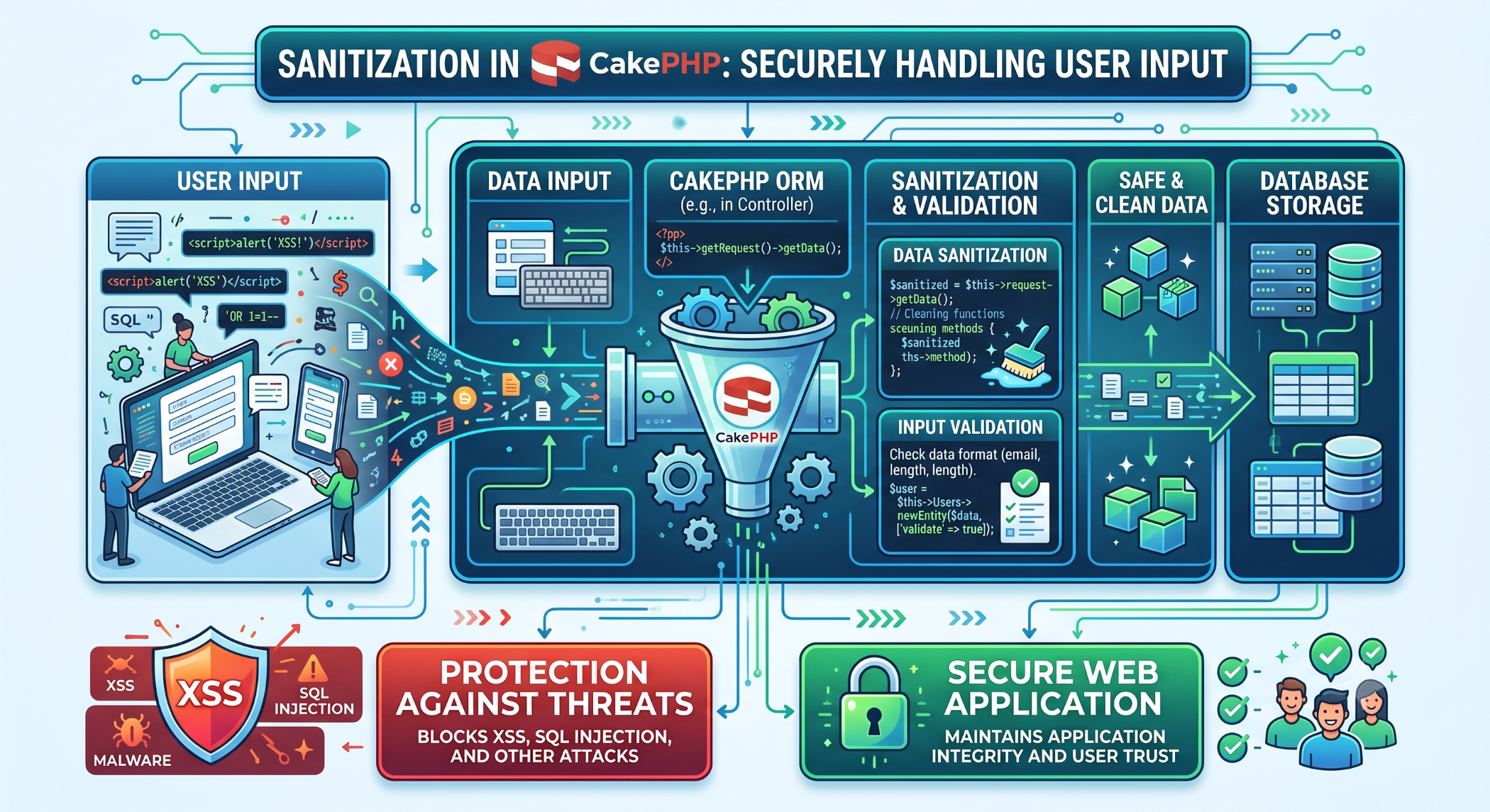
Sanitization in CakePHP: Securely Handling User Input
Web applications regularly receive data from forms, URLs, APIs, cookies, and other external sources. This data should be treated as untrusted until it has been properly checked and handled.
In CakePHP, input validation and safe data handling are important for protecting applications against invalid data and security problems. Sanitization can be useful when data needs to be normalized or cleaned, but it should be combined with validation and context-specific security controls.
What Is Sanitization?
Sanitization is the process of cleaning or transforming data into an acceptable format before it is used by an application.
For example, an application may remove unnecessary whitespace from a value:
$name = trim($name);The exact approach should depend on what the application expects to receive and how the data will eventually be used.
Sanitization and Validation Are Different
Validation determines whether input meets defined requirements.
For example, a CakePHP application may require an email address to have a valid format before accepting it.
Sanitization, on the other hand, transforms input where appropriate.
A good application should not silently alter invalid business data when rejecting it would be more appropriate.
Validate Input in CakePHP
CakePHP provides validation functionality that can be used to define rules for application data.
For example:
$validator
    ->email('email')
    ->requirePresence('email')
    ->notEmptyString('email');
This allows the application to verify that the submitted value satisfies the expected requirements.
Validation rules should reflect actual business requirements rather than relying on generic rules for every field.
Use CakePHP ORM Safely
When working with database data, developers should use CakePHP's ORM and query-building capabilities rather than constructing SQL queries by concatenating user input.
For example:
$query = $this->Users->find()
    ->where(['email' => $email]);
Using parameterized query mechanisms helps keep user data separate from SQL instructions.
Sanitize Output for Its Context
Input sanitization should not be considered a replacement for output encoding.
When data is displayed in HTML, it should be escaped appropriately. CakePHP provides escaping capabilities through its view layer and helpers.
For example, application output should be encoded according to the context in which it is rendered rather than assuming that input was made safe when it was received.
Handling HTML Content
Applications sometimes allow users to submit rich HTML content, such as comments or article content.
In these cases, simply removing a few characters is not sufficient. Use a dedicated HTML sanitization strategy with an allowlist of permitted elements and attributes.
The application should explicitly decide which HTML is allowed rather than trusting submitted markup.
Form Data and Request Parameters
CakePHP applications can receive data through request objects.
For example:
$email = $this->request->getData('email');The retrieved value should be validated before being used in business logic.
Do not assume that a field is safe simply because it came from a form or because the frontend performs validation.
File Upload Sanitization
File uploads require additional controls.
Applications should validate:
- File size
- File type
- File extension
- File content
- Storage location
Do not trust the filename or MIME type supplied by the client.
Uploaded files should be stored securely and should not automatically be executable.
Avoid Over-Sanitization
Over-sanitizing data can damage legitimate information.
For example, changing user input unnecessarily may alter names, addresses, search terms, or other business data.
Instead of trying to clean every value with the same rule, define what the application expects and apply the appropriate control for that context.
Best Practices for CakePHP
Use CakePHP validation rules for business and data requirements, use the ORM for safe database access, escape output according to its context, and apply specialized sanitization when accepting rich HTML or file uploads.
Keep security checks on the server even when client-side validation is implemented.
Conclusion
Sanitization in CakePHP is part of a broader strategy for handling untrusted input safely. Developers should combine validation, appropriate data transformation, secure database access, output encoding, and access controls rather than depending on a single sanitization function.
By applying the appropriate security measure at each stage of the data lifecycle, CakePHP applications can remain more secure, reliable, and maintainable.