What Is SDLC?
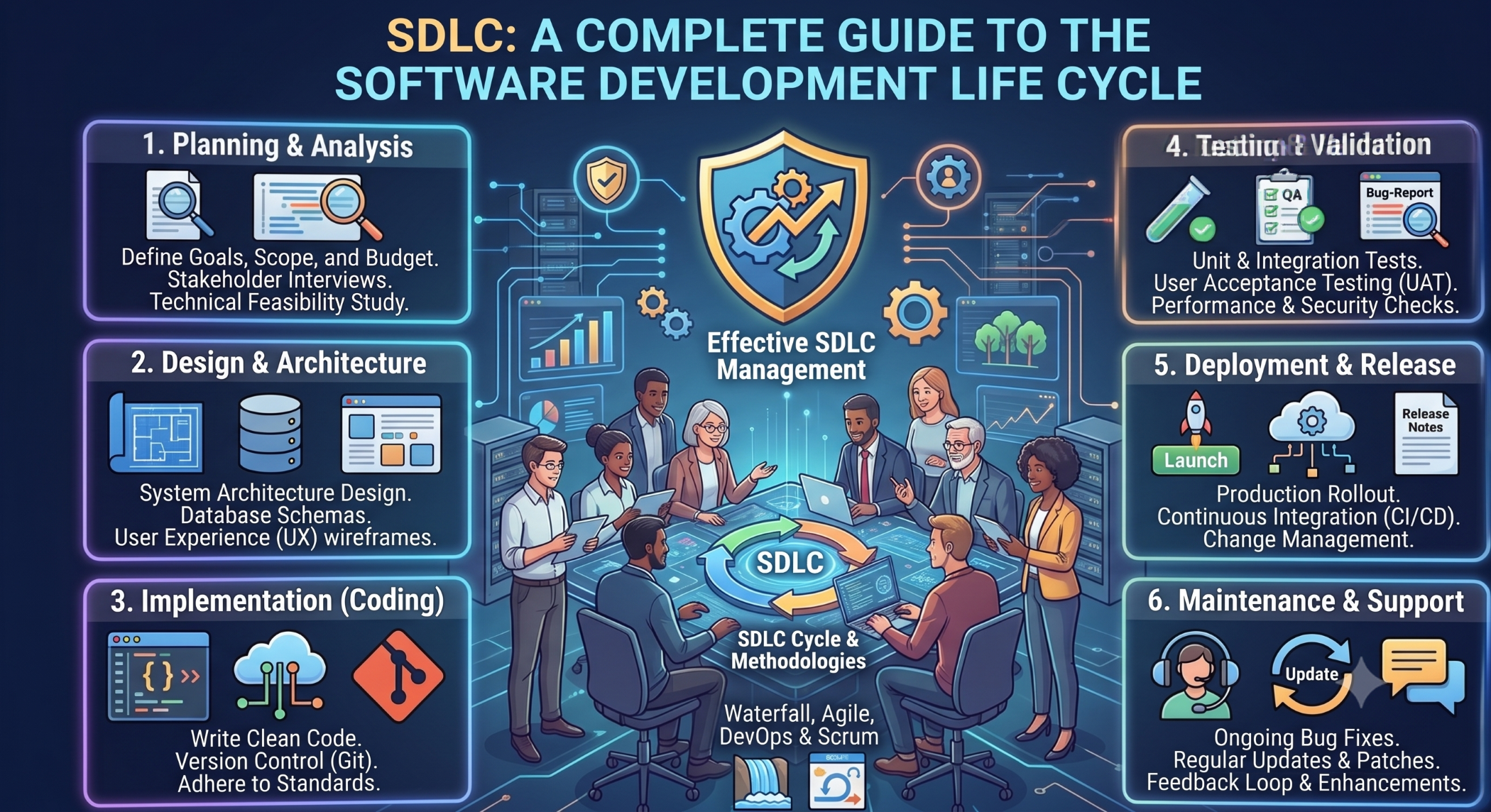
SDLC, or Software Development Life Cycle, is a structured process used by software teams to plan, design, develop, test, deploy, and maintain software applications.
The purpose of SDLC is to organize software development into manageable activities, improve visibility and planning, reduce project risks, and help teams deliver software that meets business and customer requirements. AWS describes SDLC as a process intended to improve software quality while supporting planning, estimation, risk management, and systematic delivery.
SDLC is not a single development methodology. Different organizations use different SDLC models depending on project size, complexity, risk, requirements, and expected frequency of change.
Why Is SDLC Important?
Software development involves many interconnected activities.
Requirements need to be understood before development begins. Architecture and design need to support the requirements. Developers need to implement the solution, testers need to validate it, and operations teams need to deploy and maintain it.
Without a structured approach, projects can experience unclear requirements, uncontrolled changes, missed dependencies, quality problems, cost overruns, and delivery delays.
A defined SDLC creates a common framework for stakeholders and development teams. It can improve planning, estimation, visibility, risk management, and communication throughout the project.
Major Phases of SDLC
The exact phases can differ between organizations and methodologies, but modern SDLC approaches commonly include requirements and planning, design and architecture, implementation, testing, deployment, and operation or maintenance.
1. Requirement Analysis and Planning
The first stage is understanding what the software needs to achieve.
The team works with stakeholders to identify business objectives, user requirements, functional requirements, technical constraints, integrations, risks, budget considerations, and expected outcomes.
Requirements should be documented clearly enough that both business and technical stakeholders have a shared understanding of what is being built.
Planning may also cover project scope, resources, schedules, dependencies, priorities, and acceptance criteria.
Strong planning at this stage can reduce ambiguity later in the project.
2. System Design and Architecture
Once the requirements are understood, the team develops the technical approach.
Architects and developers determine how the application should be structured and how its components will interact.
This stage can include decisions about:
Technology stack
Application architecture
Database design
API architecture
Authentication and authorization
Infrastructure
Third-party integrations
Scalability
Security
A well-designed architecture should support the business requirements without introducing unnecessary complexity.
3. Implementation
The implementation phase is where developers turn the approved design into working software.
Development work is generally divided into manageable tasks or features.
Depending on the methodology, developers may work on the application incrementally and integrate changes continuously.
Good implementation practices include source-control management, code reviews, coding standards, automated checks, documentation, and appropriate testing.
AI-assisted development is also increasingly being integrated into software workflows for activities such as requirements analysis, architecture assistance, coding, test generation, and deployment support. AWS describes generative AI as applicable across multiple SDLC activities, while emphasizing human validation and interaction throughout the process.
4. Testing
Testing verifies whether the software behaves as expected and satisfies its requirements.
Testing can include:
Unit testing: Validates individual components.
Integration testing: Checks interactions between components or systems.
Functional testing: Verifies business functionality.
Regression testing: Ensures existing functionality continues to work after changes.
Performance testing: Evaluates behavior under expected or demanding workloads.
Security testing: Identifies vulnerabilities and security weaknesses.
User acceptance testing: Confirms that the system meets business expectations.
Modern SDLC practices increasingly treat testing as an activity that occurs throughout development rather than only at the end. AWS also notes that automated and manual testing can operate alongside development.
5. Deployment
After the application has been validated, it can be deployed to the production environment.
Deployment may involve building release packages, configuring environments, migrating databases, configuring infrastructure, setting permissions, and enabling monitoring.
Separating development, testing, and production environments helps teams make changes without unnecessarily affecting users of the live application.
Modern CI/CD practices can automate many deployment activities and make software releases more repeatable.
6. Maintenance and Operations
Software development does not end when an application is released.
Production systems require ongoing maintenance, monitoring, support, security updates, bug fixes, performance optimization, and new features.
Teams may also need to respond to changing business requirements, updated third-party services, infrastructure changes, and new security threats.
AWS identifies maintenance activities such as fixing bugs, resolving customer issues, and monitoring system performance, security, and user experience as part of the software lifecycle.
Popular SDLC Models
Different SDLC models organize development activities in different ways.
Waterfall Model
The Waterfall model follows a sequential approach where development moves through defined stages.
Requirements are generally established before design, followed by implementation, testing, and deployment.
This can provide structure and predictability when requirements are well understood and unlikely to change significantly.
However, substantial changes later in the process can be costly because earlier phases may already be complete. AWS identifies Waterfall as a sequential model with limited flexibility once a phase has been completed.
Iterative Model
The Iterative model develops software through repeated cycles.
Instead of attempting to complete everything in one pass, teams build an initial version and improve it through subsequent iterations.
This approach allows teams to learn from earlier versions and incorporate new information into later cycles.
Spiral Model
The Spiral model combines iterative development with strong emphasis on risk analysis.
It is particularly useful when projects are large, complex, or associated with significant uncertainty.
Teams repeatedly evaluate risks, develop solutions, and refine the software through successive cycles.
Agile Model
Agile development uses short development cycles and incremental delivery.
Teams continuously evaluate requirements, development results, and customer feedback and adjust their plans accordingly.
Agile is useful when requirements are likely to change or when stakeholders benefit from receiving working functionality throughout the project.
AWS describes Agile SDLC as iterative and incremental, enabling teams to respond more quickly to change and engage stakeholders throughout development.
SDLC and Security
Security should not be postponed until after development.
Modern software teams increasingly integrate security into the entire SDLC.
This approach is often associated with DevSecOps, where developers, security professionals, and operations teams work together to address security throughout development and deployment.
Security activities can include architecture reviews, threat modeling, secure coding practices, dependency analysis, vulnerability scanning, code reviews, penetration testing, and continuous monitoring.
AWS recommends integrating security into development rather than treating security testing as a completely separate final-stage activity.
SDLC and DevOps
DevOps brings development and operations activities closer together.
Traditional software processes can involve significant handoffs between development, testing, and operations teams.
DevOps practices can automate build, testing, deployment, infrastructure management, monitoring, and release processes.
This can shorten feedback loops and make software delivery more repeatable.
The development experience can also be improved by integrating source control, development environments, testing frameworks, collaboration systems, and deployment tools into a more connected workflow.
SDLC and Agile Are Not the Same Thing
SDLC refers broadly to the lifecycle of software development.
Agile is one way of organizing software development within that lifecycle.
A company can have an SDLC while using Agile, Waterfall, iterative, or another development model.
Understanding this distinction is useful because SDLC defines the overall lifecycle, while the chosen methodology determines how the work moves through that lifecycle.
Benefits of Following SDLC
A structured SDLC can provide several benefits.
Better planning: Teams can identify requirements, resources, dependencies, and risks earlier.
Improved visibility: Stakeholders can understand the status and deliverables associated with different stages.
Better quality: Testing and validation can be integrated into the development process.
Risk reduction: Potential technical and business problems can be identified earlier.
Improved cost management: Defined planning and estimation can help teams manage resources more effectively.
Clearer responsibilities: Teams can understand who is responsible for activities and deliverables.
These benefits are among the reasons AWS describes SDLC as a framework for improving planning, estimation, risk management, software delivery, and customer satisfaction.
SDLC for Web Applications
Web applications can involve frontend interfaces, backend services, databases, APIs, authentication, cloud infrastructure, and third-party integrations.
SDLC helps coordinate these different components.
For example, a development team building an e-commerce application may begin by defining customer and business requirements, design the application architecture, implement product and checkout functionality, test payment and order workflows, deploy the application, and then continuously monitor and improve it.
SDLC for Mobile Applications
Mobile application development also benefits from a structured lifecycle.
Requirements may include supported platforms, device compatibility, authentication, notifications, offline functionality, API integration, data protection, and mobile-specific user experiences.
Testing should cover relevant devices, operating systems, screen sizes, connectivity conditions, and application workflows.
After release, mobile applications also require maintenance to address operating-system updates, security issues, compatibility problems, and new business requirements.
SDLC for Enterprise Applications
Enterprise applications can involve complex workflows, multiple user roles, legacy systems, integrations, compliance requirements, and large numbers of users.
For these systems, SDLC can provide greater structure around architecture, security, testing, deployment, documentation, and operational readiness.
AWS also describes operational readiness as something that can be integrated across the SDLC rather than treated solely as a final pre-launch activity.
Role of Documentation in SDLC
Documentation supports communication across the project lifecycle.
Depending on the project, useful documentation can include requirements, architecture diagrams, API specifications, database designs, deployment procedures, testing scenarios, security decisions, and operational documentation.
Good documentation reduces dependency on individual team members and makes future maintenance easier.
Stakeholder Involvement
SDLC is not only a technical process.
Business owners, product managers, clients, project managers, designers, developers, testers, security specialists, and operations teams may all contribute during different stages.
Stakeholder involvement is especially important during requirements, validation, acceptance testing, and feedback cycles.
Clear communication can reduce the gap between what the business expects and what the technical team develops.
Common SDLC Challenges
SDLC itself does not guarantee project success.
Projects can still encounter problems when requirements are unclear, communication is poor, scope changes are unmanaged, estimates are unrealistic, dependencies are ignored, or quality is not adequately addressed.
Another challenge is treating the SDLC as a rigid checklist rather than adapting it to the needs of the project.
The process should provide useful structure without creating unnecessary bureaucracy.
Improving the SDLC Process
Organizations can strengthen their SDLC by making expectations clear from the beginning.
Requirements should be understandable and traceable to business objectives.
Development and testing should happen continuously where appropriate.
Security should be considered throughout the lifecycle.
Automation can reduce repetitive manual work.
Monitoring and operational readiness should be considered before production release.
Teams should also review completed work and use lessons learned to improve future development cycles.
The Future of SDLC
Software development is increasingly influenced by cloud computing, automation, DevOps, artificial intelligence, and continuous delivery.
Generative AI can assist with requirements analysis, architecture, coding, testing, documentation, deployment, operations, and incident management. At the same time, human review and validation remain important when AI-generated outputs affect technical and business decisions.
The SDLC is therefore evolving rather than disappearing. Its core objective remains the same: creating a structured and repeatable way to transform business requirements into reliable software and continuously improve that software after release.
How Solace Infotech Can Help
A successful software project requires more than development expertise. It requires requirements analysis, architecture, UI/UX, development, QA, deployment, project management, and ongoing support.
Solace Infotech provides software development services across web, mobile, enterprise, and other digital solutions. A structured SDLC approach can help align these activities with business objectives and provide visibility throughout the project lifecycle.
Conclusion
SDLC provides a structured framework for building and maintaining software.
From requirements and planning through architecture, development, testing, deployment, and maintenance, each stage contributes to the quality and success of the final product.
Different projects may use different SDLC models, including Waterfall, Iterative, Spiral, Agile, and hybrid approaches. The appropriate model depends on requirements, project complexity, risk, business priorities, and expected changes.
Modern SDLC practices also integrate security, automation, DevOps, continuous testing, cloud technologies, and increasingly artificial intelligence.
The most effective SDLC is not necessarily the most complicated one. It is the process that gives the team enough structure to manage risk and quality while remaining flexible enough to meet real business needs.