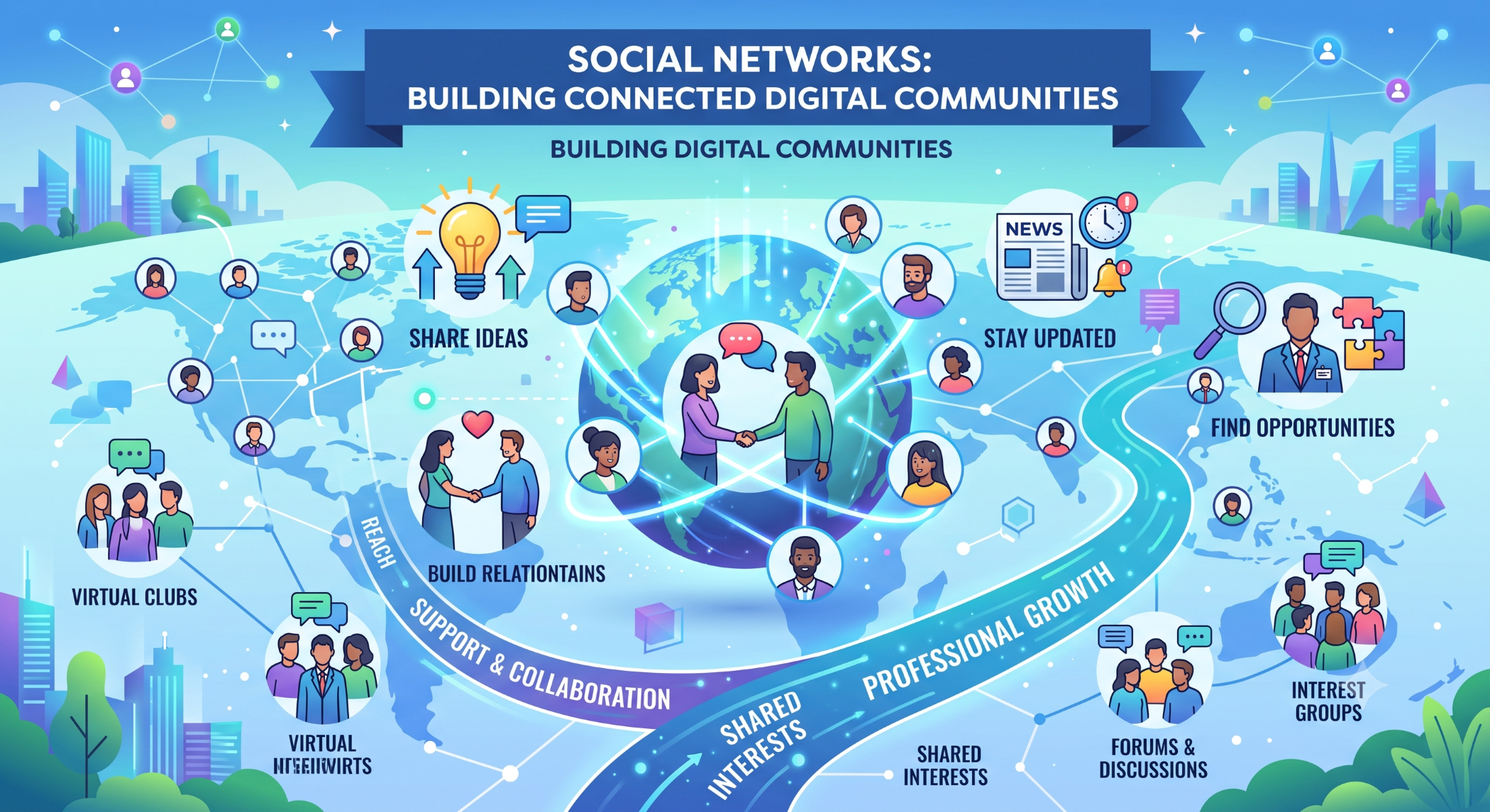
Social Networks: Building Connected Digital Communities
Social networks have transformed how people communicate, discover information, build communities, and interact with businesses. Modern social networking platforms combine user profiles, messaging, content sharing, notifications, search, recommendations, and real-time interactions.
For businesses, a social network can also become a platform for customer engagement, professional collaboration, community building, and digital services.
What Is a Social Network?
A social network is a digital platform that allows users to connect and interact with other users or organizations.
Typical social networking features include:
User profiles
Connections or followers
Posts and content sharing
Comments and reactions
Private messaging
Notifications
Search
Groups or communities
The exact functionality depends on the purpose of the platform and its target audience.
How Does a Social Network Work?
A social networking platform generally combines a frontend application, backend services, databases, file storage, communication services, and supporting infrastructure.
A simplified architecture looks like:
User
↓
Web / Mobile Application
↓
API / Backend
↓
Database + Cache + Storage
↓
Notifications / Realtime Services
The backend handles activities such as authentication, profile management, content processing, relationships, messaging, and notifications.
Key Features of Social Networking Platforms
User Profiles
Users can create profiles containing information such as names, photographs, descriptions, interests, professional details, or other relevant information.
Profile information should be protected through appropriate privacy and access controls.
Connections and Followers
Social networks allow users to create relationships with other users.
Depending on the platform, these may be represented as friendships, followers, subscriptions, or professional connections.
Content Sharing
Users can publish posts containing text, images, videos, documents, and other media.
A well-designed content system should also support moderation, reporting, and appropriate visibility controls.
Messaging
Private and group messaging can provide direct communication between users.
Realtime technologies such as WebSockets can be used when messages need to appear immediately.
Notifications
Notifications can inform users about new messages, comments, reactions, connection requests, and other activities.
Notification preferences should allow users to control the type and frequency of alerts they receive.
Realtime Communication
Realtime functionality can make social networking platforms more interactive.
For example:
User A Posts
↓
Backend Event
↓
Realtime Service
↓
Connected Users
↓
Updated Feed
WebSockets, server-sent events, push notifications, and other technologies can be used depending on the communication requirement.
Database Design
Social networking platforms can generate large amounts of data.
The database may need to manage:
Users
Profiles
Connections
Posts
Comments
Reactions
Messages
Notifications
Media metadata
Database structure and indexing should be planned around real application access patterns because inefficient queries can become a major bottleneck as the platform grows.
Search and Discovery
Search functionality helps users find people, posts, communities, products, or other content.
Larger platforms may use specialized search technologies to provide fast results across large datasets.
Recommendation and discovery systems can also help surface relevant content to users.
Social Network Security
Security is critical because social platforms manage personal information and user-generated content.
Important areas include:
Secure authentication
Authorization
Privacy controls
Input validation
Secure file uploads
Rate limiting
Account protection
API security
Applications should also prevent users from accessing private content or performing actions they are not authorized to perform.
Content Moderation
User-generated content creates additional operational requirements.
Platforms may need mechanisms for:
Reporting inappropriate content
Blocking users
Moderating posts
Detecting spam
Managing abusive behavior
Reviewing policy violations
Depending on the platform, automated tools and human moderation can work together.
Scaling a Social Network
As user numbers grow, the architecture must support increasing requests, content, media, and realtime activity.
A scalable architecture may include:
Users
↓
CDN / Load Balancer
↓
Application Servers
↓
Cache + Realtime Layer
↓
Database + Object Storage
Cloud infrastructure, caching, queues, load balancing, and horizontal scaling can help support growing workloads.
Mobile Social Networking Apps
Many social platforms are primarily used through mobile applications.
Mobile apps should be designed for different screen sizes, network conditions, battery constraints, and operating-system behaviors.
Features such as push notifications, camera access, location, media uploads, and realtime messaging may require platform-specific considerations.
Social Networks for Businesses
Businesses can build specialized social platforms for specific communities or industries.
Examples include:
Professional networks
Customer communities
Employee collaboration platforms
Interest-based communities
Educational networks
Industry-specific platforms
A focused network can provide more relevant features and experiences than a general-purpose platform.
Social Network Development at Solace Infotech
Solace Infotech works across web applications, mobile development, APIs, databases, cloud technologies, realtime communication, and product development.
These capabilities can be combined to develop customized social networking platforms based on requirements such as user profiles, communities, messaging, content sharing, notifications, media management, and integrations.
Best Practices
Define the target community and primary user problem before development. Start with the core social interactions and introduce additional features as the platform gains users.
Design privacy and security controls from the beginning, optimize database queries, protect user-generated content, and plan for scalability based on expected usage.
Analytics and user feedback should be used to understand engagement and continuously improve the platform.
Conclusion
Social networks provide powerful digital environments for communication, community building, content sharing, and user engagement.
A successful social networking platform requires more than a good interface. It depends on secure user management, efficient databases, realtime communication, scalable infrastructure, content moderation, and a clear understanding of the community it serves.
With the right technology and product strategy, businesses can build social platforms that create meaningful and long-term digital communities.