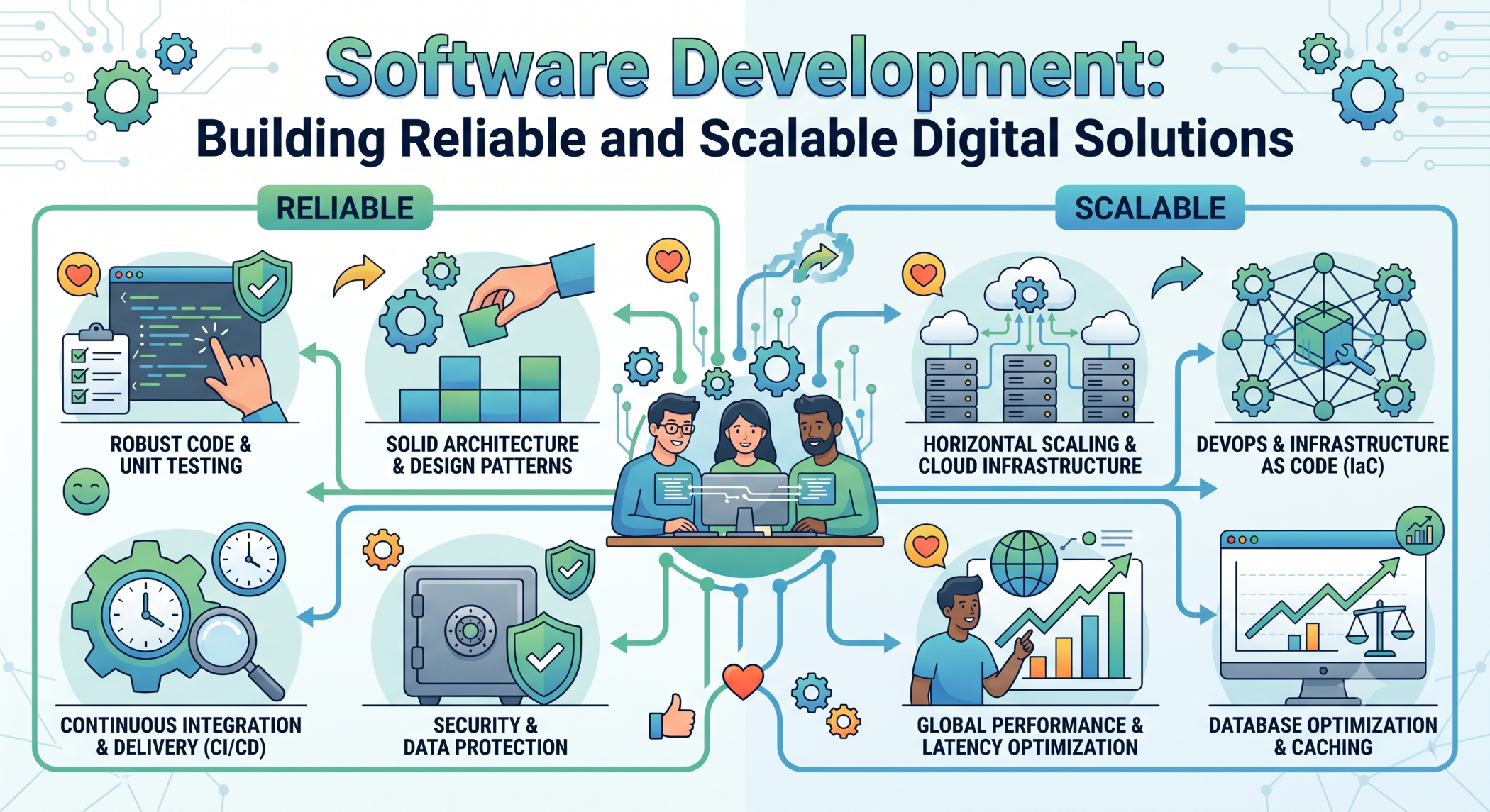
Software Development: Building Reliable and Scalable Digital Solutions
Software has become an essential part of modern businesses, helping organizations automate operations, serve customers, manage information, and create new digital products. Software development is the process of designing, building, testing, deploying, and maintaining applications that solve specific business or user problems.
Successful development requires more than writing code. It involves understanding requirements, selecting appropriate technologies, designing a suitable architecture, testing functionality, and continuously improving the product.
What Is Software Development?
Software development is a structured process used to create and maintain software applications.
A typical development lifecycle includes:
Requirements
↓
Planning
↓
UI/UX Design
↓
Development
↓
Testing
↓
Deployment
↓
Maintenance
The process can vary depending on the project's size, methodology, technology, and business requirements.
Requirement Analysis
Development should begin with a clear understanding of the problem being solved.
Teams typically identify:
Business objectives
Target users
Required features
Integrations
Security requirements
Performance expectations
Budget and timeline
Well-defined requirements help reduce misunderstandings and unnecessary rework during development.
Software Architecture
Architecture defines how different parts of the application work together.
A typical web application may include:
User
↓
Frontend
↓
Backend / API
↓
Database
↓
External Services
The architecture should be selected according to factors such as application complexity, scalability, data requirements, security, and expected usage.
Frontend Development
The frontend is the part of an application users interact with.
Common technologies include:
HTML
CSS
JavaScript
React
Angular
TypeScript
A good frontend should provide clear navigation, responsive layouts, accessibility, and efficient performance.
Backend Development
The backend manages business logic, authentication, APIs, database operations, and application processing.
Depending on the project, developers may use technologies such as:
PHP
Laravel
Node.js
Python
.NET
The backend should be designed to remain secure, maintainable, and scalable as application requirements increase.
Database Development
Most business applications require persistent data storage.
Developers may use relational databases such as MySQL or other database technologies depending on the data model and project requirements.
Good database design includes appropriate tables, relationships, constraints, indexes, and optimized queries.
Testing and Quality Assurance
Testing helps identify defects before they reach users.
Software teams may perform:
Functional testing
Integration testing
API testing
Performance testing
Security testing
Browser and device testing
Regression testing
Automated testing can also help detect regressions as an application evolves.
Security in Software Development
Security should be considered throughout the development lifecycle rather than added after the application is completed.
Important practices include:
Server-side input validation
Secure authentication
Authorization and access controls
Secure API design
Protected credentials
HTTPS
Dependency updates
Secure data storage
The level of security required depends on the type of application and information being handled.
Software Performance
Application performance depends on multiple layers.
Developers may need to optimize:
Frontend
↓
Backend
↓
Database
↓
Network
↓
Infrastructure
Caching, efficient database queries, optimized assets, asynchronous processing, and scalable infrastructure can improve performance when applied to the appropriate bottleneck.
Agile Software Development
Many development teams use iterative approaches such as Agile to deliver software incrementally.
A typical cycle may look like:
Plan
↓
Develop
↓
Test
↓
Review
↓
Release
↓
Improve
This allows teams to incorporate feedback and adapt as requirements change.
Software Development and Cloud Technology
Cloud platforms can provide infrastructure for application hosting, databases, storage, monitoring, and scalable services.
Cloud deployment can also support distributed teams and flexible infrastructure, but businesses should consider cost, security, availability, and compliance when selecting a cloud strategy.
Modern Software Development
Modern development increasingly combines technologies such as:
APIs
Cloud computing
Artificial Intelligence
Automation
Mobile applications
Microservices
Real-time communication
Technology selection should be driven by the application's actual requirements rather than trends.
Software Development at Solace Infotech
Solace Infotech provides software development capabilities across web applications, mobile apps, APIs, PHP, Laravel, Node.js, Angular, React, TypeScript, AI, cloud technologies, e-commerce, and custom business software.
Solutions can be developed for new digital products, business process automation, application modernization, integrations, and ongoing product development.
Best Practices
Start with a clear business problem, define requirements before development, and choose technologies according to the project's real needs.
Use modular architecture, maintain clean and testable code, build security into every layer, monitor production performance, and continuously improve the application based on user feedback and measurable results.
Conclusion
Software development combines business requirements, engineering, design, testing, security, and continuous improvement to create useful digital products and applications.
A successful development process does not end when software is deployed. Ongoing monitoring, maintenance, security updates, and improvements are necessary to keep applications reliable and aligned with changing business needs.
By choosing the right architecture, technology, development practices, and delivery approach, businesses can create software that is secure, scalable, maintainable, and capable of supporting long-term growth.