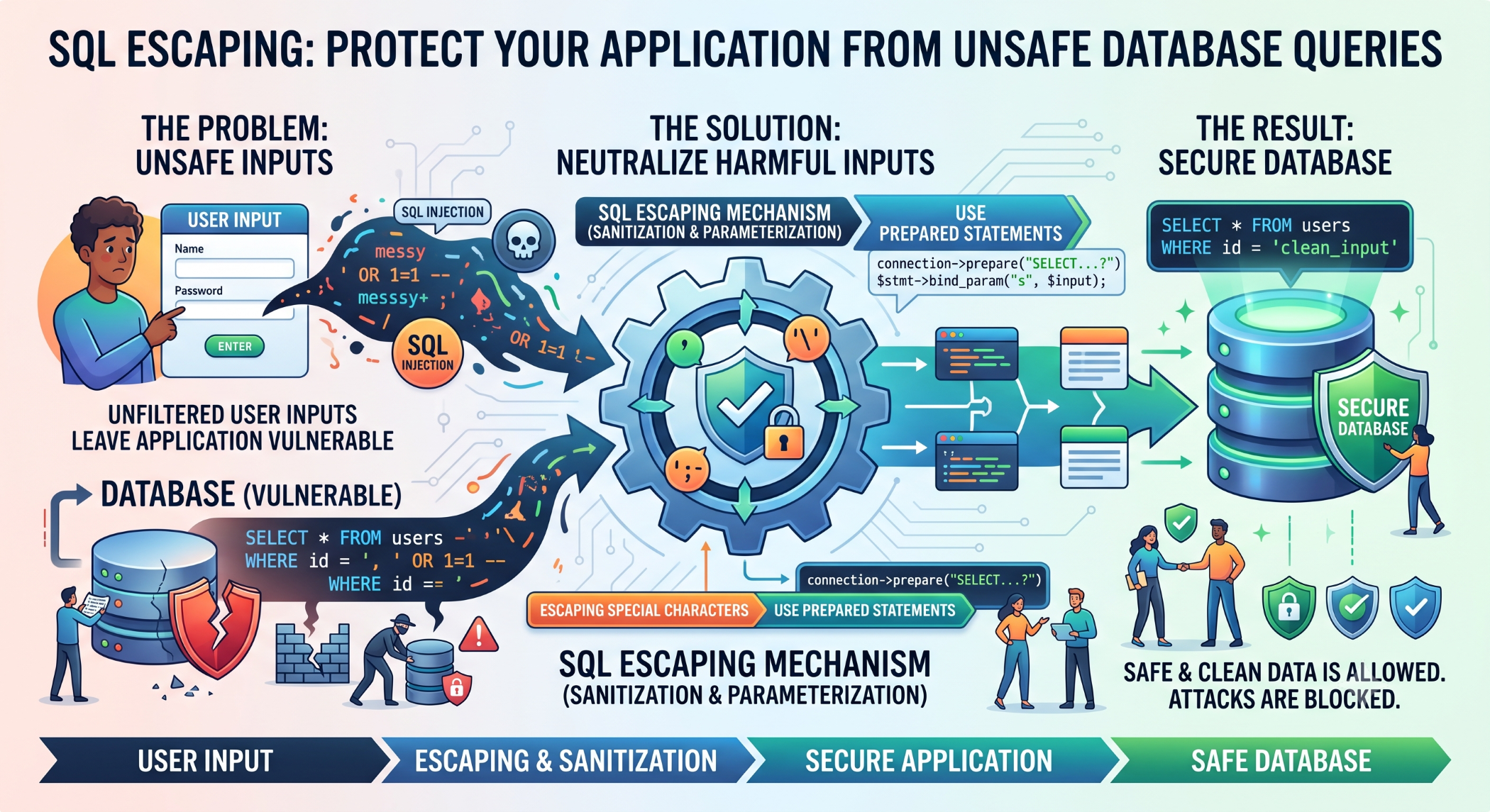
SQL Escaping: Protect Your Application from Unsafe Database Queries
Web applications frequently use user-provided data in database queries. Search forms, login fields, contact forms, and API requests can all send values that eventually reach a database.
When this data is inserted into SQL incorrectly, it can cause malformed queries or create security vulnerabilities such as SQL injection.
SQL escaping is one technique used to handle special characters in data, but modern applications should generally prefer parameterized queries and prepared statements.
What Is SQL Escaping?
SQL escaping means modifying special characters in a value so that they are treated as data rather than SQL syntax.
For example, a text value may contain characters that have special meaning to a SQL parser.
Historically, developers often escaped values before constructing SQL strings manually.
Why Is SQL Escaping Important?
Incorrectly handling user input can result in:
- SQL syntax errors.
- Unexpected query behavior.
- Data exposure.
- Unauthorized database operations.
- SQL injection vulnerabilities.
Database input should therefore never be trusted simply because it comes from a website form or frontend application.
SQL Injection Example
Consider a query constructed by concatenating user input:
$sql = "SELECT * FROM users WHERE email = '" . $email . "'";This approach is unsafe because the value of $email becomes part of the SQL statement itself.
An attacker may be able to manipulate the input so that the resulting SQL behaves differently from what the developer intended.
Why Prepared Statements Are Better
Instead of manually escaping values, use prepared statements.
For example, with PDO:
$stmt = $pdo->prepare(
    "SELECT id, name FROM users WHERE email = :email"
);

$stmt->execute([
    'email' => $email
]);
The SQL structure and the supplied value are handled separately.
This is a much stronger and more maintainable approach for preventing SQL injection.
SQL Escaping in PHP
PHP provides database-specific escaping functions, such as mysqli_real_escape_string() for MySQLi connections.
Example:
$email = mysqli_real_escape_string($connection, $email);

$sql = "SELECT * FROM users WHERE email = '$email'";
However, escaping requires the correct database connection and character-set configuration, and it is easier to introduce mistakes than when using parameterized queries.
For new development, prepared statements should generally be preferred.
Escaping Is Not Validation
Escaping and validation solve different problems.
Validation determines whether data follows the rules expected by the application.
For example, an age may need to be an integer:
$age = filter_var($age, FILTER_VALIDATE_INT);Escaping or parameterization protects data when it is used in a particular technical context.
A value can be valid from a business perspective and still require safe handling when sent to a database.
SQL Escaping vs HTML Escaping
Escaping is context-specific.
SQL-related protections should be used for database queries.
HTML output should use HTML-appropriate encoding, for example:
echo htmlspecialchars($name, ENT_QUOTES, 'UTF-8');Using an HTML escaping function to protect SQL queries, or vice versa, is incorrect.
Each output context needs its own security mechanism.
Avoid Building Dynamic SQL With User Input
Be especially careful with queries where users influence SQL structure, such as table names, column names, or sort directions.
Prepared statements generally parameterize values, not arbitrary SQL identifiers.
When dynamic identifiers are required, use an allowlist of accepted values rather than directly inserting user input into the SQL statement.
For example:
$allowedSorts = ['name', 'created_at'];

$sort = in_array($sort, $allowedSorts, true)
    ? $sort
    : 'created_at';
Best Practices for SQL Security
Treat all external input as untrusted. Use prepared statements for database values, validate data according to business requirements, use allowlists for dynamic SQL identifiers, and keep database accounts limited to the permissions they actually need.
Do not rely on escaping alone as your primary SQL injection defense.
Conclusion
SQL escaping has an important place in the history of secure database development, but modern applications should generally use prepared statements and parameterized queries instead of manually constructing SQL strings.
Secure database development requires more than escaping characters. It combines validation, parameterized queries, least-privilege database access, and context-specific security practices.
By separating data from SQL instructions, developers can build database-driven applications that are safer, more reliable, and easier to maintain.