Take Advantage of Native PHP Functions
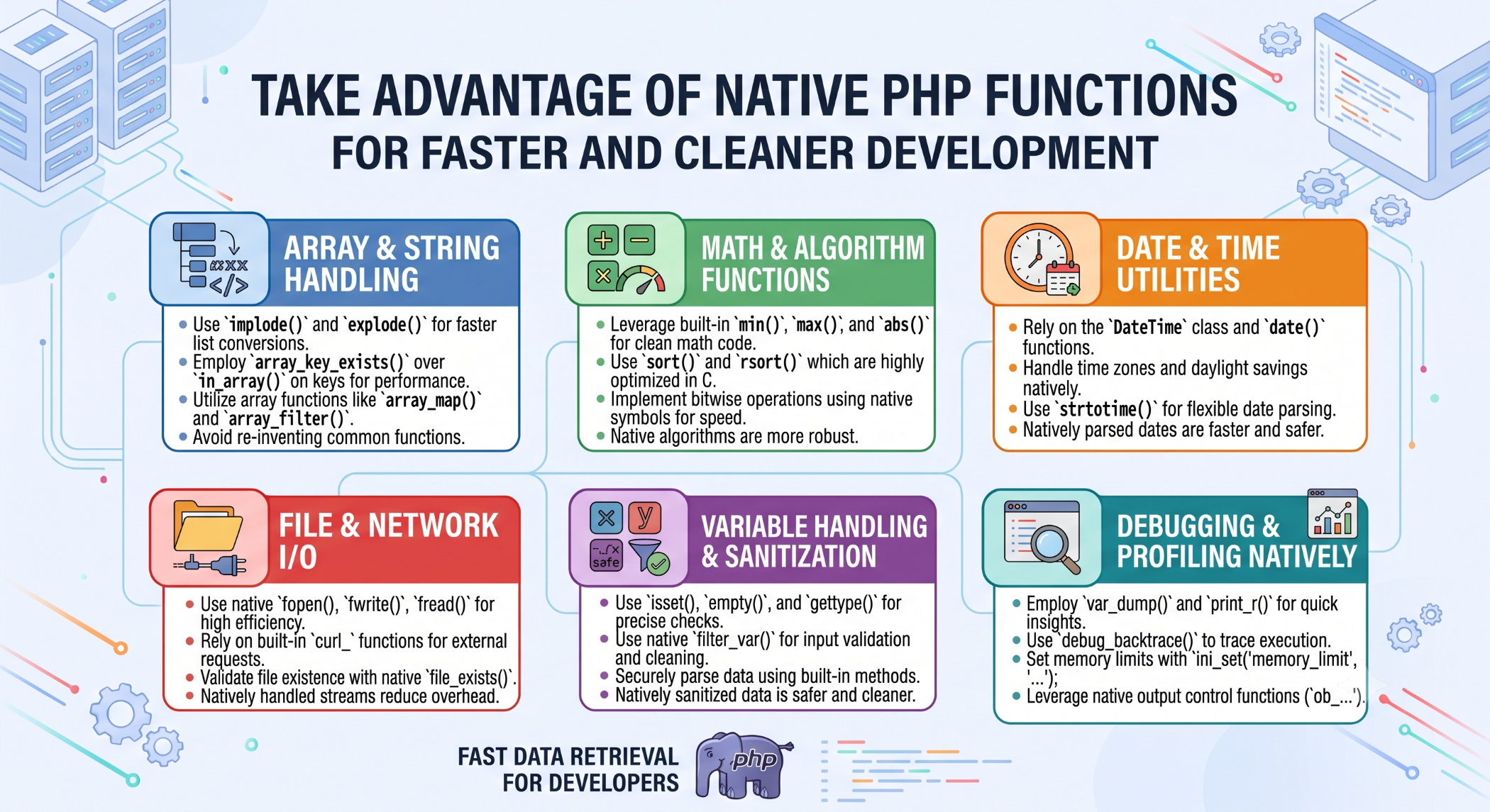
Developers often create custom solutions for tasks that PHP already provides through its built-in functionality. Using native PHP functions can make applications simpler, reduce development effort, and improve code readability.
PHP includes functions for handling strings, arrays, files, dates, numbers, JSON, and many other common programming requirements.
Why Use Native PHP Functions?
Before writing a custom implementation, developers should check whether PHP already provides a suitable function.
Using native functions can help:
- Reduce development time.
- Minimize duplicate code.
- Improve code readability.
- Make maintenance easier.
- Use functionality that is already part of the PHP ecosystem.
Working With Strings
PHP provides many functions for common string operations.
$text = "Welcome to PHP";

echo strlen($text);
echo strtolower($text);
echo strtoupper($text);
Other useful functions include trim(), substr(), strpos(), and str_replace().
These functions can simplify text validation, formatting, searching, and manipulation.
Working With Arrays
Arrays are frequently used in PHP applications, and PHP includes many functions for processing them.
$products = ["Laptop", "Phone", "Tablet"];

echo count($products);

sort($products);
Functions such as count(), sort(), array_merge(), in_array(), array_filter(), and array_map() can eliminate the need for repetitive custom logic.
File Handling
PHP also provides native functions for reading, writing, and managing files.
$content = file_get_contents("data.txt");

echo $content;
Functions such as file_put_contents(), file_exists(), and fopen() can support common file operations.
File access should always be implemented with appropriate permissions and security controls.
Date and Time Functions
Date and time operations are common in business applications.
echo date("Y-m-d");PHP provides functions for formatting dates, working with timestamps, and performing date calculations.
Applications serving users across regions should also handle time zones carefully.
JSON Processing
Modern applications frequently exchange data using JSON.
PHP makes this easy with native functions:
$data = [
    "name" => "John",
    "status" => "active"
];

$json = json_encode($data);

$result = json_decode($json, true);
These functions are particularly useful when developing APIs and integrating frontend applications with PHP backends.
Mathematical and Utility Functions
PHP also provides native functions for common mathematical and utility operations.
echo max(10, 20, 30);
echo min(10, 20, 30);
echo round(12.56);
Using these functions keeps code concise and makes the intention of the operation clear.
Avoid Reinventing Existing Functionality
Suppose an application needs to check whether a value exists in an array.
Instead of manually looping through every element, developers can use:
if (in_array("PHP", $skills)) {
    echo "Found";
}
This is shorter, easier to understand, and uses functionality already provided by PHP.
Native Functions and Performance
Native functions can often be preferable to unnecessarily complicated custom implementations, but developers should still measure performance when optimization matters.
The primary advantage is usually simplicity, readability, and reduced development effort, rather than assuming every native function will automatically be faster in every scenario.
Best Practices
Understand the parameters, return values, and behavior of a native function before using it. Use appropriate validation when processing user input, and do not treat a built-in function as a replacement for application-level security.
PHP documentation should be consulted when behavior differs across PHP versions.
Conclusion
Taking advantage of native PHP functions can significantly simplify application development. From strings and arrays to files, dates, JSON, and mathematical operations, PHP provides a broad set of ready-to-use capabilities.
Instead of rebuilding functionality that already exists, developers should use the right native function, keep the code simple, and focus custom development on functionality that genuinely requires it.