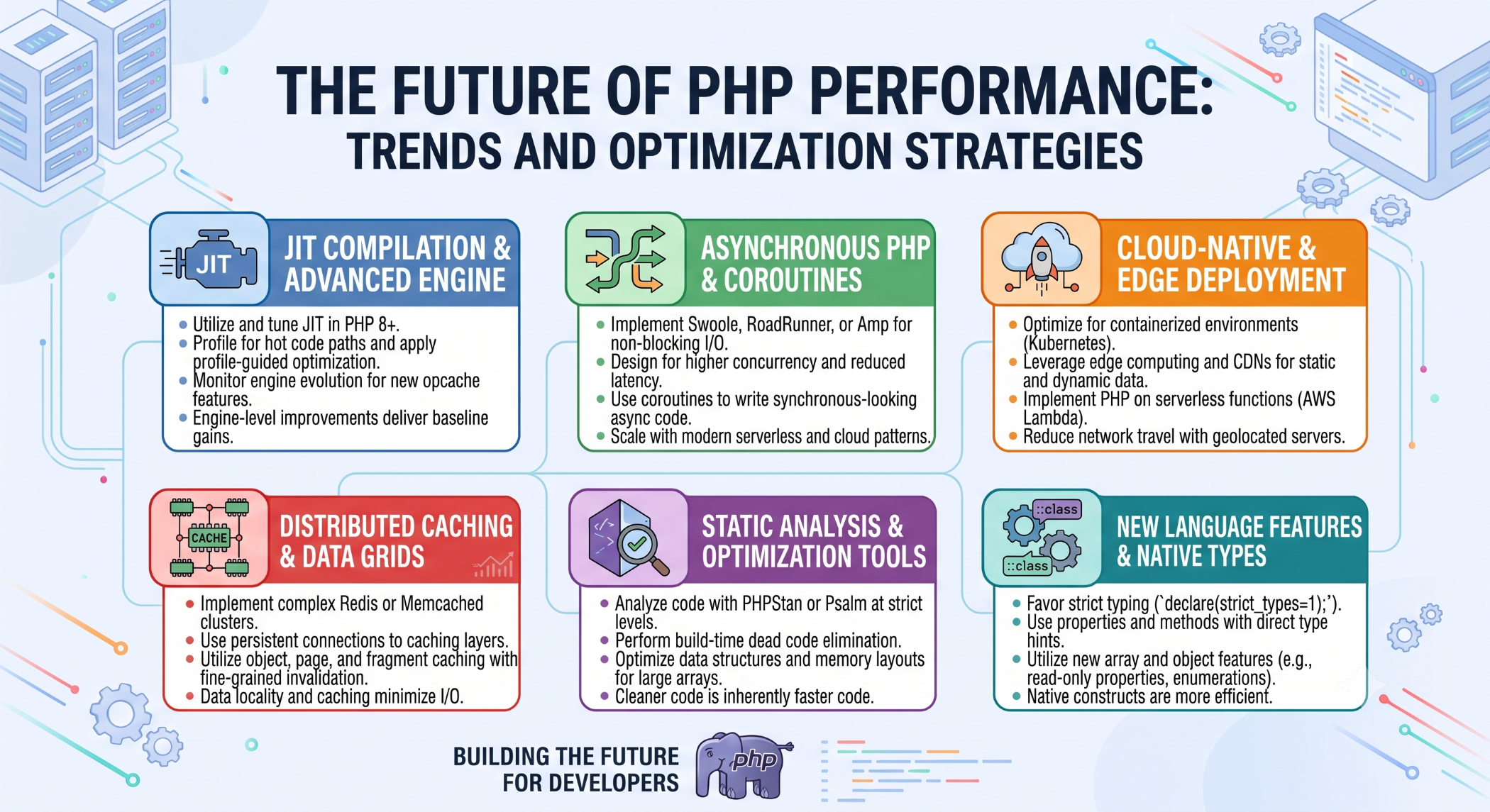
The Future of PHP Performance: Trends and Optimization Strategies
PHP has continued to evolve from a traditional server-side scripting language into a modern platform capable of supporting demanding web applications, APIs, SaaS products, and enterprise systems.
As applications become more complex, PHP performance will continue to depend on improvements in the PHP runtime as well as better application architecture, database optimization, caching, and infrastructure.
Current PHP releases demonstrate that performance remains an active area of development. PHP 8.4 introduced performance improvements and a new JIT implementation based on the IR framework, while PHP 8.5 continued the focus on performance and introduced additional runtime improvements.
Faster PHP Runtime
One of the major factors shaping the future of PHP performance is continued improvement in the language runtime.
PHP's recent releases include performance improvements alongside language and runtime enhancements. This means developers can benefit from a faster platform by keeping applications on actively supported PHP versions and taking advantage of improvements included in newer releases.
PHP 8.5, released in November 2025, also introduced improvements such as persistent cURL share handles, which can reduce repeated connection initialization costs in applicable workloads.
The Role of JIT
PHP introduced Just-In-Time compilation through OPcache in PHP 8.0. JIT is designed to provide native-code execution for suitable workloads, although its benefits depend heavily on the application's characteristics.
Developers should therefore avoid assuming that enabling JIT automatically makes every web application faster.
For typical applications, database queries, network requests, caching, application architecture, and I/O are often more important performance considerations than raw PHP execution.
OPcache and Application Performance
OPcache remains an important part of PHP production deployments. It can cache compiled PHP bytecode so that scripts do not need to be compiled repeatedly for each request.
PHP's current documentation provides configuration options for both OPcache and JIT, giving administrators control over how PHP code is cached and optimized.
A properly configured production environment can therefore reduce unnecessary runtime overhead.
Database Optimization Will Remain Important
PHP performance is closely connected to database performance.
An application can have highly optimized PHP code and still be slow if it performs inefficient database queries.
Developers should continue to focus on:
Query optimization
Appropriate database indexes
Connection management
Efficient data retrieval
Caching frequently requested data
For MySQL-based applications, database configuration and query performance should be monitored together with PHP performance.
Caching and Distributed Architectures
As applications scale, caching will continue to play an important role.
Application-level caches, object caches, HTTP caching, and CDNs can reduce repeated processing and database requests.
Larger applications may also separate responsibilities across services, queues, background workers, and multiple application servers.
This allows PHP applications to handle increasing workloads without relying entirely on a single server.
PHP and Modern Infrastructure
The future of PHP performance is not limited to the PHP language itself.
Containerization, cloud infrastructure, managed databases, load balancing, faster storage, and observability tools can all contribute to application performance.
A modern PHP deployment may look like:
Users
↓
CDN / Load Balancer
↓
PHP Application Servers
↓
Cache + Database
↓
Background Workers
This architecture allows businesses to scale individual components according to actual demand.
Upgrade to Supported PHP Versions
Keeping PHP updated is increasingly important for both performance and security.
PHP follows a defined support lifecycle. Currently supported branches include PHP 8.2, 8.3, 8.4, and 8.5, with each branch receiving active support followed by security-only support.
Running an outdated PHP version can prevent an application from benefiting from newer runtime improvements and can eventually create security and compatibility concerns.
Measure Before Optimizing
The future of PHP performance will also involve better measurement and observability.
Developers should use profiling and monitoring to determine where applications actually spend time.
Important metrics include:
Request response time
PHP execution time
Database latency
Memory usage
CPU utilization
External API latency
Cache hit rates
Optimization should always target measurable bottlenecks rather than assumptions.
What Businesses Should Expect
Businesses should think about PHP performance as a combination of modern runtime technology, efficient application code, optimized databases, caching, and scalable infrastructure.
Upgrading PHP can provide a useful foundation, but simply moving to a newer version will not fix inefficient queries or poorly designed application architecture.
The strongest results come from improving the complete technology stack.
Conclusion
The future of PHP performance looks closely connected to continuous runtime improvements, better OPcache capabilities, evolving JIT technology, efficient application architecture, and increasingly sophisticated infrastructure.
PHP 8.4 and 8.5 show that the language continues to invest in performance and modern runtime capabilities, while the ongoing PHP 8.6 development cycle indicates that the platform continues to evolve.
For businesses running PHP applications, the best long-term strategy is to stay on supported PHP versions, measure real performance, optimize application and database bottlenecks, and scale infrastructure according to actual demand.