Introduction
Time is one of the most valuable resources in both professional and personal life. Unlike money or other resources, lost time cannot be recovered.
Effective time management is therefore essential for professionals who need to balance multiple responsibilities, deadlines, meetings, projects, and unexpected challenges.
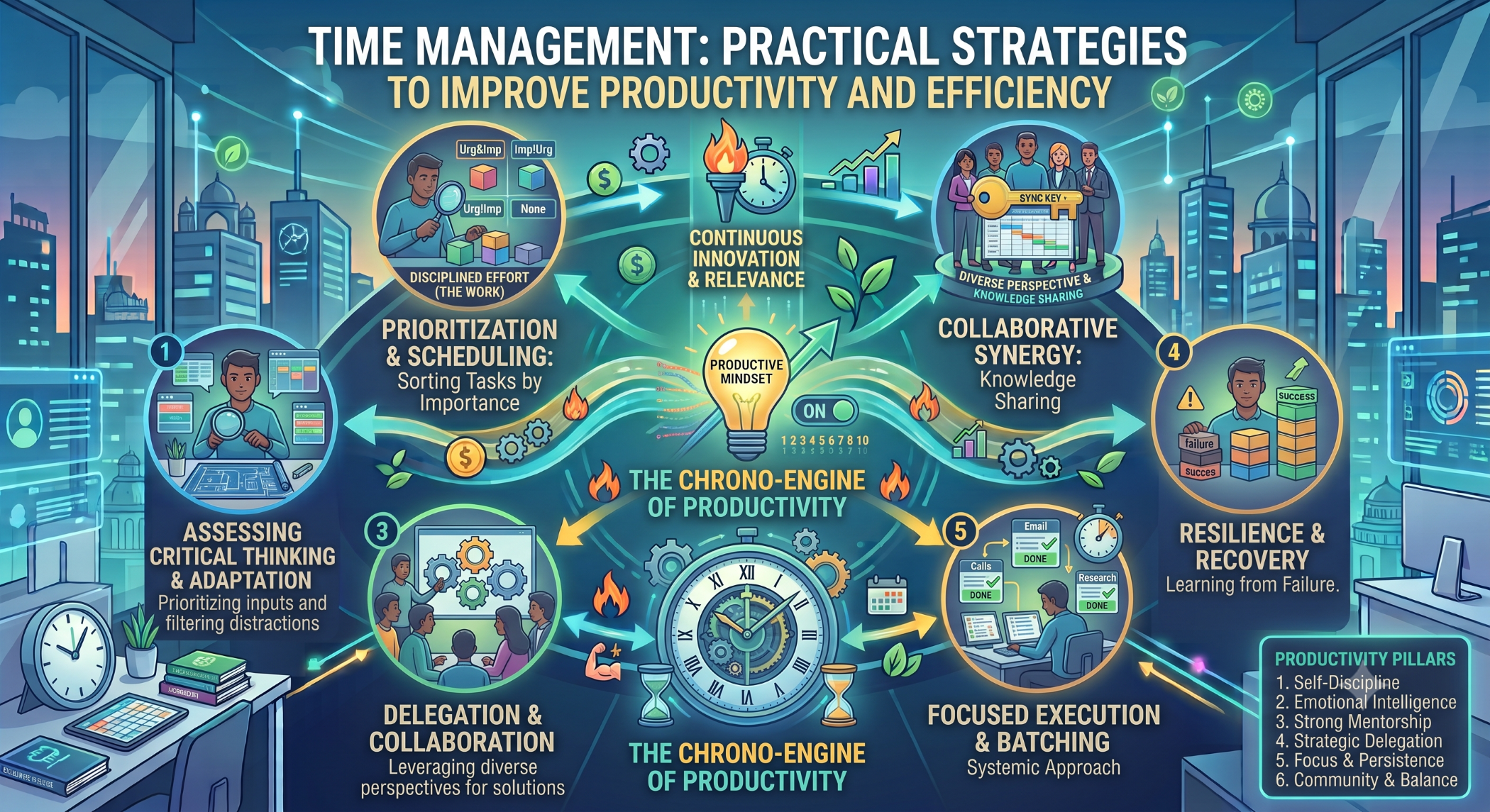
Time management is not about trying to stay busy throughout the day. It is about deciding where your time should be invested so that the most important work receives the attention it deserves. Common approaches include prioritization, scheduling, goal setting, timeboxing, and structured task management.
What Is Time Management?
Time management is the process of organizing and planning how available time is used across different activities.
Good time management helps answer an important question:
What should I work on now, and what can wait?
Professionals often have more tasks than they can realistically complete at the same time. Without clear priorities, urgent messages, meetings, and minor tasks can consume the day while important work remains unfinished.
Effective time management provides structure so that time is directed toward high-value activities.
Why Time Management Matters
Poor time management can lead to missed deadlines, unnecessary stress, incomplete tasks, reduced quality, and inefficient use of resources.
Good time management can help professionals:
Improve productivity: More attention can be given to meaningful work.
Meet deadlines: Planned work is easier to track and complete on schedule.
Reduce distractions: Unnecessary interruptions can be controlled.
Improve work quality: Important tasks receive sufficient time and attention.
Create better balance: Work can be organized more realistically instead of allowing everything to become urgent.
Set Clear Goals
Time management begins with knowing what you want to accomplish.
Goals provide direction and help determine which activities deserve priority.
Instead of creating a vague objective such as “work on the project,” define a specific outcome such as “complete the API integration and prepare it for testing.”
Clear objectives make it easier to estimate effort, organize tasks, and measure progress.
Prioritize Your Tasks
Not every task has the same importance.
One of the simplest ways to improve time management is to distinguish between urgent and important activities. The Eisenhower approach, for example, separates work according to urgency and importance so that important long-term activities do not continually get pushed aside by less important urgent demands.
A useful priority system can divide tasks into:
High priority: Important work that directly affects key goals or deadlines.
Medium priority: Necessary work that can be scheduled after higher-value activities.
Low priority: Activities that can be postponed, delegated, automated, or eliminated.
Prioritization prevents the common mistake of treating every task as equally important.
Create a Daily Plan
Starting the day without a plan can make it easy to react to whatever arrives first.
A simple daily plan can include the most important tasks, meetings, deadlines, and time reserved for unexpected work.
The objective is not to fill every minute. A realistic plan should include some flexibility because unexpected issues are part of most work environments.
Planning also provides a clear reference point throughout the day.
Use Timeboxing
Timeboxing means allocating a defined amount of time to a particular task or activity.
For example, instead of working on a report without a defined limit, allocate 60 minutes to complete the first draft.
Timeboxing can improve focus, prevent tasks from consuming excessive amounts of time, and create a stronger sense of urgency. It is also used as a technique for organizing tasks, improving focus, and managing workload.
Avoid Constant Multitasking
Multitasking may appear productive, but continuously switching between unrelated tasks can make focused work more difficult.
For example, writing code while repeatedly checking email and responding to chat messages can interrupt the thought process required to solve a complex technical problem.
Whenever possible, group similar activities together and dedicate uninterrupted periods to important work.
Control Interruptions
Notifications, phone calls, meetings, emails, and instant messages can consume significant amounts of attention.
This does not mean every communication should be ignored. Instead, communication should be managed deliberately.
For example, email can be reviewed at scheduled times rather than continuously throughout the day. Structured email handling approaches can also involve deciding whether a message should be acted on, deleted, delegated, or prioritized for later action.
Reducing unnecessary interruptions makes it easier to maintain concentration.
Learn to Delegate
Time management is not about doing everything personally.
Delegation allows appropriate tasks to be assigned to people with the relevant skills or responsibility.
Managers in particular can lose significant amounts of time when they continue performing tasks that could be handled by their team members.
Effective delegation also creates opportunities for team members to develop new skills and take ownership.
Learn to Say No
One reason people struggle with time management is that they accept too many requests.
Every new commitment consumes time that could otherwise be used for existing priorities.
Saying no does not necessarily mean being uncooperative. It can mean explaining current priorities and identifying a more appropriate time or alternative person to handle the request.
Protecting your priorities is an important part of managing your time effectively.
Avoid Procrastination
Procrastination occurs when important work is repeatedly delayed even when there is a clear reason to complete it.
Large or complicated tasks can sometimes create resistance because they appear overwhelming.
Breaking a large task into smaller actions can make it easier to start.
Instead of thinking, “I need to finish the entire project,” identify the first practical step and complete it.
Once progress begins, subsequent tasks often become easier to manage.
Manage Meetings Carefully
Meetings can be useful for decision-making, collaboration, and communication, but poorly structured meetings can consume large amounts of time.
Before scheduling a meeting, determine whether the objective can be achieved through a message, document, or quick discussion.
When a meeting is necessary, define the purpose and expected outcome. Keeping the discussion focused can help prevent unnecessary time consumption.
Track How You Spend Your Time
Many people underestimate how much time is spent on low-value activities.
Tracking work for several days can reveal patterns such as excessive meetings, repeated interruptions, unnecessary administrative work, or frequent task switching.
Time tracking can therefore be used as a diagnostic tool.
Once you understand where time is being spent, you can decide which activities should be reduced, delegated, automated, or eliminated.
Use Technology Wisely
Technology can either improve time management or make it worse.
Task-management systems, calendars, reminders, collaboration tools, automation, and project-management platforms can help organize work and make priorities visible.
However, adding more tools does not automatically increase productivity.
The best system is one that is simple enough to use consistently and provides clear visibility into tasks, deadlines, responsibilities, and progress.
Time Management in Software Development
Time management is particularly important in software development because projects often involve multiple dependencies and changing requirements.
A development task may depend on design, API availability, database changes, testing, client feedback, or another team's work.
Developers should therefore estimate work realistically, identify dependencies early, communicate blockers quickly, and prioritize tasks based on project impact.
Project managers and technical leads also need to balance planned work with unexpected production issues and client requests.
Time Management for Project Managers
Project managers are often responsible for multiple activities at the same time.
They need to coordinate people, communicate with clients, monitor project progress, manage risks, review deadlines, and resolve issues.
Without proper time management, managers can spend the majority of their day responding to immediate requests rather than working on strategic priorities.
Scheduling focused time for planning, communication, risk management, and team support can make the role more effective.
Focus on Results, Not Activity
Being busy does not necessarily mean being productive.
A person may spend an entire day answering messages and attending meetings without making meaningful progress on important objectives.
Effective time management therefore focuses on results rather than activity.
Ask yourself:
What did I actually accomplish today?
Which tasks created the most value?
What could have been avoided or delegated?
What should receive my attention tomorrow?
These questions can help shift the focus from simply staying busy to achieving meaningful outcomes.
Continuous Improvement
Time management is an ongoing process.
A strategy that works today may need to change as responsibilities increase or priorities shift.
Regularly reviewing your workload can reveal opportunities for improvement.
You may discover that certain meetings are unnecessary, some tasks can be automated, or particular responsibilities should be delegated.
Small improvements repeated consistently can have a significant impact over time.
Conclusion
Time management is about making better choices about how your time is used.
It involves setting goals, prioritizing important work, scheduling effectively, controlling distractions, delegating appropriately, and regularly reviewing how time is spent.
In today's workplace, professionals often have more demands than available hours. The solution is not simply to work longer. It is to work more deliberately.
When time is managed effectively, professionals can improve productivity, maintain better focus, meet important deadlines, and devote more attention to the work that creates the greatest value.