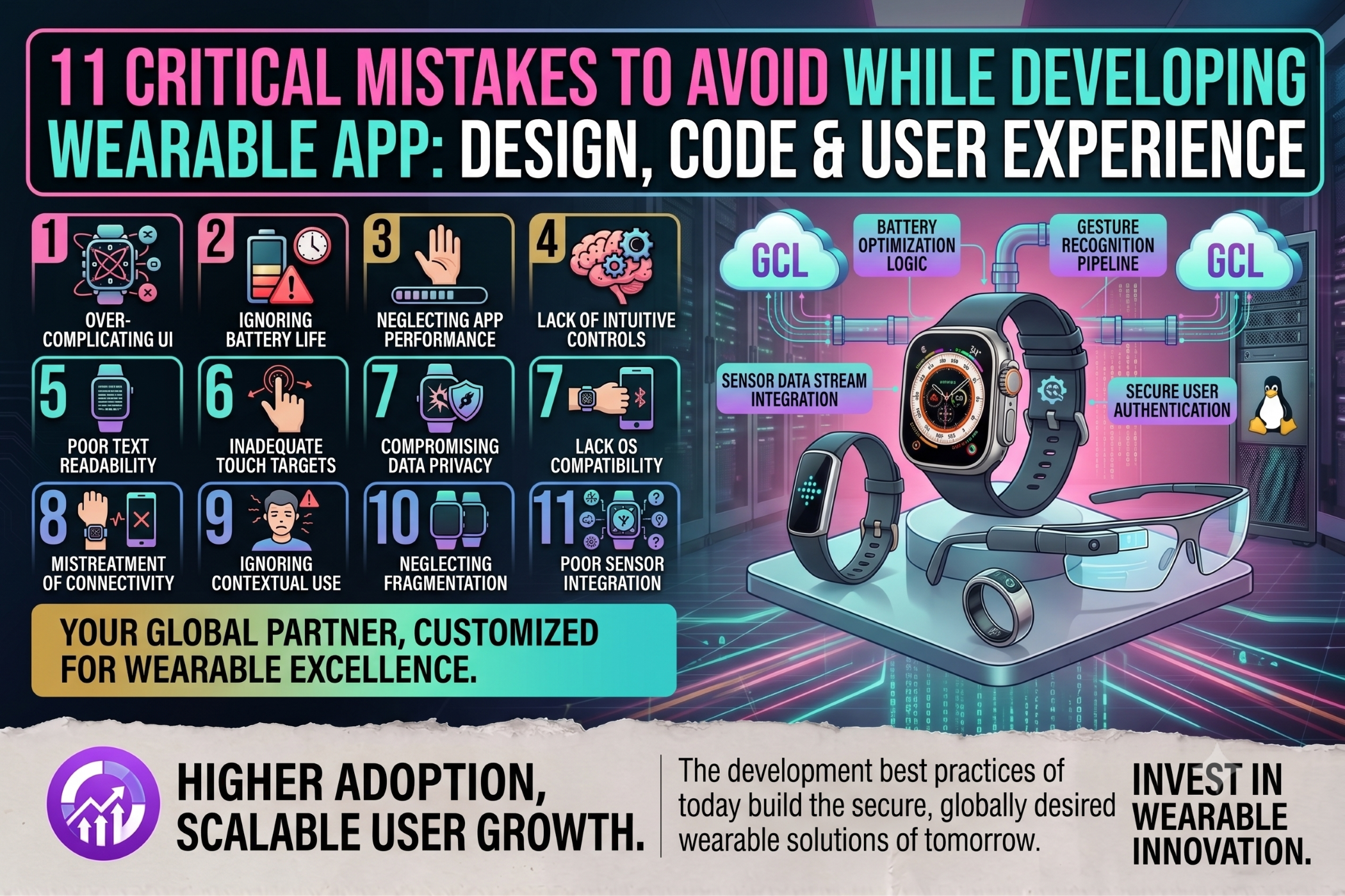
Top 11 Mistakes to Avoid While Developing Wearable App
Wearable devices have become an important part of the connected technology ecosystem. Smartwatches, fitness trackers, healthcare devices, smart glasses, and other wearable technologies provide users with convenient access to information and real-time functionality.
However, developing a successful wearable application requires a different approach from traditional mobile app development. Wearable devices have smaller screens, limited resources, battery constraints, different interaction patterns, and varying hardware capabilities.
Avoiding common wearable app development mistakes can help businesses deliver applications that are reliable, useful, and easy to use.
1. Ignoring the Wearable User Experience
One of the biggest mistakes is treating a wearable app as a smaller version of a smartphone application.
Wearable users typically need information quickly and with minimal interaction. Complex navigation, lengthy forms, and excessive content can make the application difficult to use.
Developers should focus on:
Simple navigation
Short interactions
Clear visual hierarchy
Readable content
Quick access to important features
Minimal user input
The wearable experience should be designed specifically for the device rather than simply replicating the mobile experience.
2. Designing Without Considering Screen Size
Wearables generally have much smaller displays than smartphones. Attempting to display too much information can result in a cluttered interface.
Important information should be prioritized and presented using concise content and appropriate controls.
Before development begins, designers should consider different screen sizes, aspect ratios, orientations, and interaction patterns supported by the target devices.
3. Overlooking Battery Consumption
Battery life is a critical consideration for wearable applications.
Continuous GPS usage, sensors, Bluetooth communication, background processing, and frequent network requests can consume significant battery power.
Developers should optimize:
Background processes
Sensor usage
Location tracking
Network requests
Data synchronization
Notifications
Battery-efficient application architecture can improve the overall user experience.
4. Poor Device Compatibility
The wearable market includes devices with different operating systems, hardware capabilities, screen sizes, sensors, and APIs.
Developing for only one configuration without considering other supported devices can create compatibility issues.
Testing should cover the actual devices and operating system versions that the application intends to support.
5. Ignoring Connectivity Limitations
Wearable applications may rely on Bluetooth, Wi-Fi, cellular networks, or a connected smartphone.
Connectivity may not always be available or stable. An application that assumes continuous connectivity can produce poor user experiences when the device goes offline.
Developers should consider:
Offline functionality
Data caching
Retry mechanisms
Synchronization
Connection status
Graceful error handling
6. Making the App Too Feature-Heavy
Adding every possible feature to a wearable application can reduce usability.
Wearables are generally better suited to focused interactions such as viewing notifications, tracking activities, checking metrics, controlling devices, or performing quick actions.
Businesses should identify the most important wearable-specific use cases and prioritize them during development.
7. Neglecting Performance Optimization
Wearable devices may have fewer hardware resources than smartphones or computers.
Heavy animations, inefficient code, unnecessary background operations, and large data transfers can negatively affect application performance.
Developers should optimize memory usage, processing, network communication, and rendering to create a responsive experience.
8. Weak Security and Privacy
Wearable applications can process sensitive information, including personal data, location information, fitness information, and potentially financial or healthcare-related data.
Security should therefore be considered from the beginning of the development process.
Important areas include:
Secure authentication
Data encryption
Secure API communication
Access control
Secure local storage
Privacy protection
Appropriate permissions
Applications should collect only the information necessary for their functionality and handle user data responsibly.
9. Poor Notification Management
Notifications are one of the most common wearable use cases, but excessive notifications can quickly become frustrating.
Businesses should carefully define which events require wearable notifications.
Notifications should be:
Relevant
Short
Timely
Actionable
Easy to dismiss
Users should also have appropriate controls over notification preferences.
10. Insufficient Testing on Real Devices
Testing only with simulators or development environments is not enough for many wearable applications.
Real devices can expose issues related to:
Battery usage
Bluetooth connectivity
Sensors
Screen readability
Performance
Device movement
Network interruptions
Background execution
Testing on representative physical devices can help identify problems before the application reaches users.
11. Failing to Plan for Future Scalability
Wearable technology continues to evolve, and new devices, operating system versions, sensors, and capabilities can be introduced over time.
Building an application without considering future expansion can make later updates more expensive and complicated.
A scalable architecture should allow businesses to add new devices, features, integrations, and backend capabilities without requiring a complete application rewrite.
Best Practices for Wearable App Development
A successful wearable application should be designed around the characteristics of the target device.
Some important practices include:
Start with a clear wearable-specific use case.
Keep interactions short and intuitive.
Optimize for small screens.
Minimize battery consumption.
Handle connectivity interruptions gracefully.
Test on real wearable devices.
Protect user data.
Keep notifications relevant.
Optimize application performance.
Design the backend for scalability.
Plan for future device and platform support.
Conclusion
Developing a wearable application requires more than adapting an existing mobile application to a smaller screen. Developers need to consider user interaction, device limitations, battery consumption, connectivity, performance, security, and hardware diversity throughout the development process.
By avoiding these 11 common wearable app development mistakes, businesses can create applications that provide focused functionality while delivering a smoother and more reliable user experience across supported wearable devices.