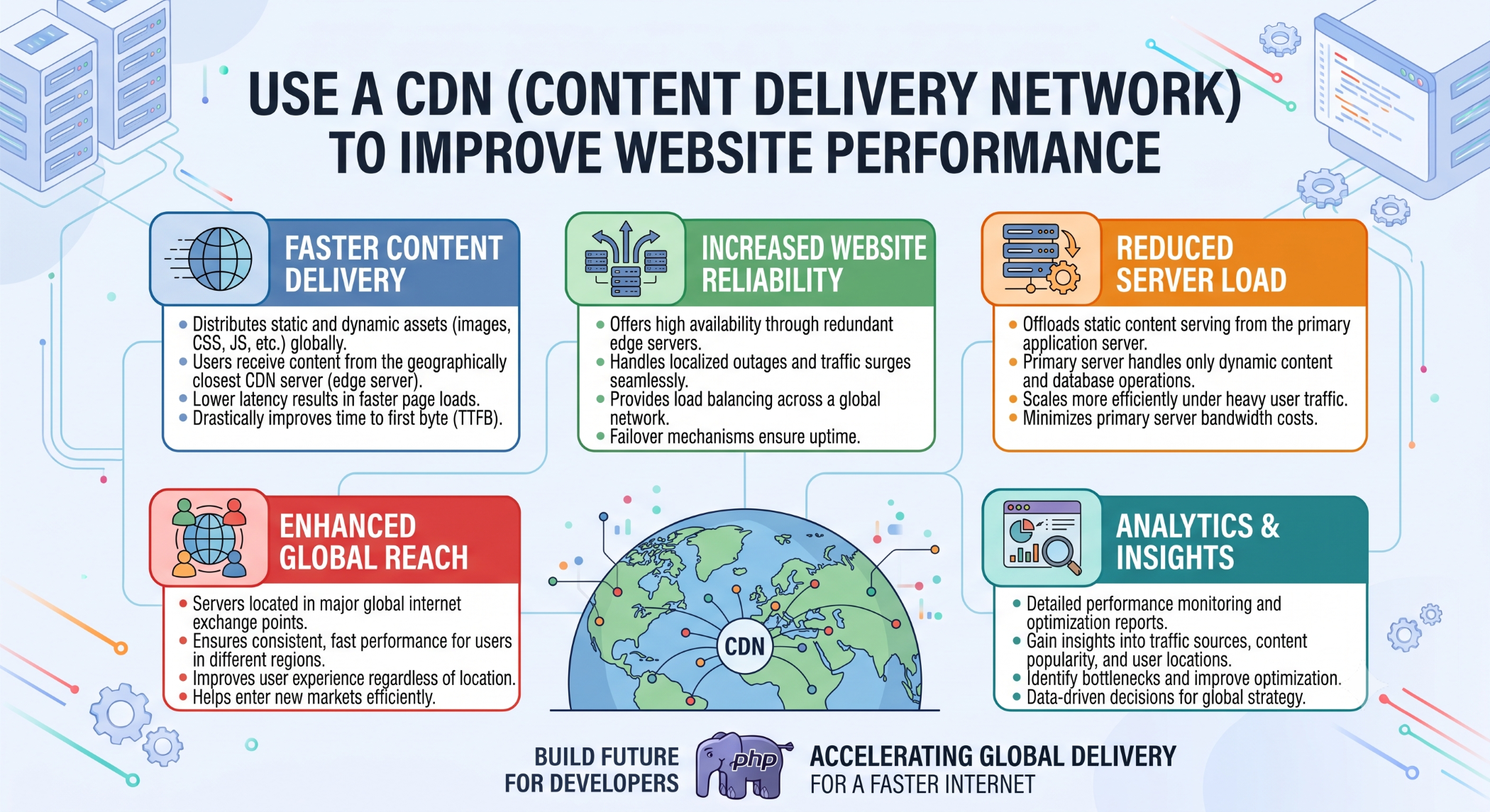
Use a CDN (Content Delivery Network) to Improve Website Performance
Website performance has a direct impact on user experience. When visitors are located far away from the main web server, latency can increase and pages may take longer to load.
A Content Delivery Network (CDN) helps address this challenge by distributing content across geographically distributed servers and delivering it from locations closer to users.
What Is a CDN?
A CDN is a network of distributed servers that delivers cached website content from an edge location closer to the person requesting it.
Instead of every request going directly to the origin server, frequently requested content can be served from a nearby CDN location.
User
  ↓
CDN Edge Server
  ↓
Origin Server
This can reduce latency and improve the delivery speed of static resources.
What Can a CDN Deliver?
CDNs are commonly used for static or cacheable resources such as:
- Images
- CSS files
- JavaScript files
- Fonts
- Videos
- Downloadable files
The exact content that should be cached depends on the application's requirements and caching configuration.
Benefits of Using a CDN
Improve Website Speed
When content is delivered from a geographically closer edge location, the distance between the user and the content can be reduced.
This can help improve page-load performance, particularly for websites serving users across multiple regions.
Reduce Origin Server Load
A CDN can serve cached files without requiring every request to reach the origin server.
This reduces repeated requests and can leave more server capacity available for dynamic application processing.
Handle Traffic Spikes
A CDN can help distribute requests for cacheable content during periods of increased traffic.
This can make a website more resilient when large numbers of users access the same resources.
Improve Global Reach
Businesses with users in different countries can benefit from distributing content through multiple edge locations rather than relying entirely on a single origin server.
CDN and Dynamic Content
A CDN does not mean that every request should be cached.
Dynamic content such as personalized dashboards, shopping carts, and authenticated responses often needs to be handled by the origin application or a carefully configured caching layer.
A good CDN strategy separates static content, cacheable content, and dynamic requests according to application requirements.
CDN and Website Performance
Using a CDN is only one part of performance optimization.
For better results, businesses should also optimize:
- Images
- CSS and JavaScript
- Database queries
- API requests
- Server-side code
- Application caching
A fast CDN cannot compensate for an inefficient backend or poorly optimized application.
Use HTTPS With Your CDN
Modern websites should use HTTPS for secure communication between users and the website.
When configuring a CDN, ensure that certificates, origin connections, redirects, and caching rules are correctly configured.
Choosing a CDN
When selecting a CDN, consider:
Geographic coverage: Choose a provider with edge locations close to your target audience.
Caching capabilities: Ensure the provider supports the content and caching behavior your application requires.
Security features: Consider capabilities such as TLS, DDoS protection, and web application security.
Monitoring: Performance and cache metrics can help identify configuration problems.
Best Practices
Start by identifying which resources benefit most from caching. Configure appropriate cache-control policies and make sure users do not receive outdated versions of frequently changing content.
Use cache invalidation or versioned asset filenames when deploying updated CSS, JavaScript, or other static resources.
Conclusion
Using a Content Delivery Network can improve website performance by serving cacheable content closer to users, reducing origin-server load, and helping applications handle traffic more efficiently.
For businesses serving users across different locations, a CDN can be an important part of a broader website performance, scalability, and reliability strategy.