Use JSON Instead of XML: Choosing the Right Data Format
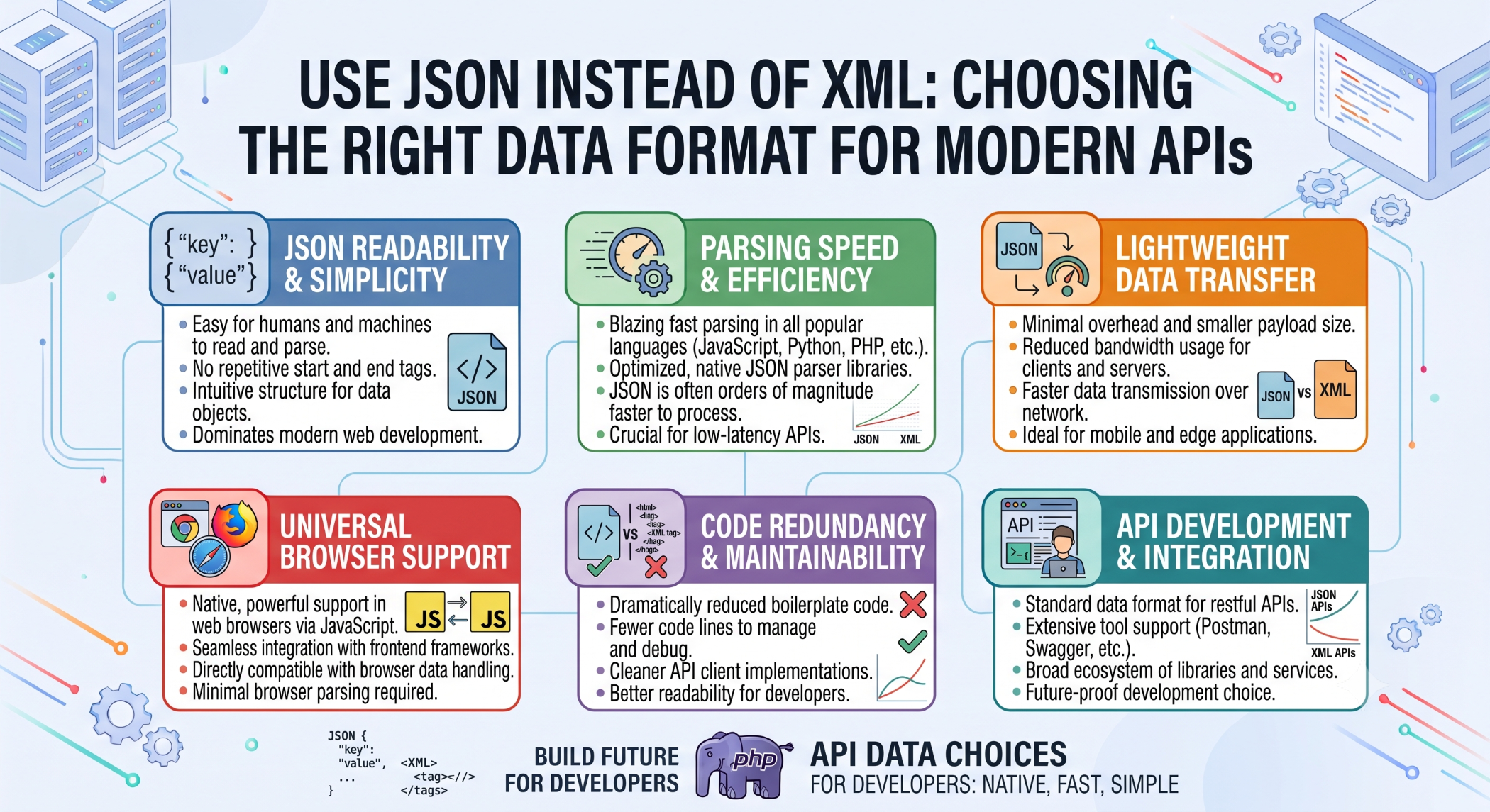
Applications often need to exchange data between different systems. For many years, XML was widely used for this purpose. Today, JSON (JavaScript Object Notation) is commonly used in web applications, APIs, and mobile applications because of its simple structure and ease of processing.
Choosing between JSON and XML should depend on the project's requirements, but JSON is often a practical choice for modern application development.
What Is JSON?
JSON is a lightweight text-based data format used to represent structured data.
A simple JSON object looks like:
{
    "name": "John",
    "email": "john@example.com",
    "status": "active"
}
Its structure is easy for both developers and applications to read and process.
What Is XML?
XML is another text-based format for representing structured information.
The same data could be represented as:
<user>
    <name>John</name>
    <email>john@example.com</email>
    <status>active</status>
</user>
XML uses opening and closing tags, which can make the same data more verbose than JSON.
JSON vs XML
Simpler Syntax
JSON generally requires less structural markup than XML.
{
    "name": "John"
}
Compared with:
<name>John</name>For applications exchanging large amounts of data, the simpler structure can make payloads easier to work with.
Easy JavaScript Integration
JSON works naturally with JavaScript and is widely supported by modern programming languages and frameworks.
For example:
const user = {
    name: "John",
    status: "active"
};
JSON is therefore commonly used for communication between browser applications and backend APIs.
Smaller Payloads
Because JSON generally uses less structural markup, JSON responses can be smaller than equivalent XML documents. This can be beneficial when applications frequently exchange data over a network.
Actual payload size depends on the structure and content of the data.
JSON for APIs
REST APIs commonly use JSON for request and response bodies.
For example:
{
    "id": 101,
    "name": "John",
    "role": "customer"
}
A frontend application or mobile app can easily parse the response and use the individual fields.
JSON in PHP
PHP provides native functions for working with JSON.
To convert a PHP array into JSON:
$data = [
    "name" => "John",
    "status" => "active"
];

$json = json_encode($data);
To convert JSON back into a PHP value:
$data = json_decode($json, true);This makes JSON particularly convenient for PHP-based APIs and web applications.
When XML May Still Be Appropriate
JSON is not always the better choice.
XML can still be useful when a project requires features such as complex document structures, XML-specific schemas, namespaces, or systems that already depend heavily on XML-based standards.
The decision should be based on interoperability requirements rather than choosing a format simply because it is newer or more popular.
Best Practices for JSON APIs
Keep JSON structures consistent, use meaningful property names, return appropriate HTTP status codes, and validate incoming data.
API responses should also be documented clearly so frontend and third-party developers know the expected request and response formats.
Conclusion
JSON provides a simple and efficient way to exchange structured data between applications. Its readable syntax, broad language support, and common use in modern APIs make it a practical choice for web and mobile development.
XML still has important use cases, but for many modern application integrations, JSON can provide a simpler and more efficient data-exchange format.