What Are Virtual Currencies?
Virtual currency is a digital representation of value that can be transferred, stored, or traded electronically. Depending on the system, it can function as a medium of exchange, a unit of account, or a store of value. Unlike traditional fiat currency, virtual currency is generally not issued or guaranteed by a central bank or government.
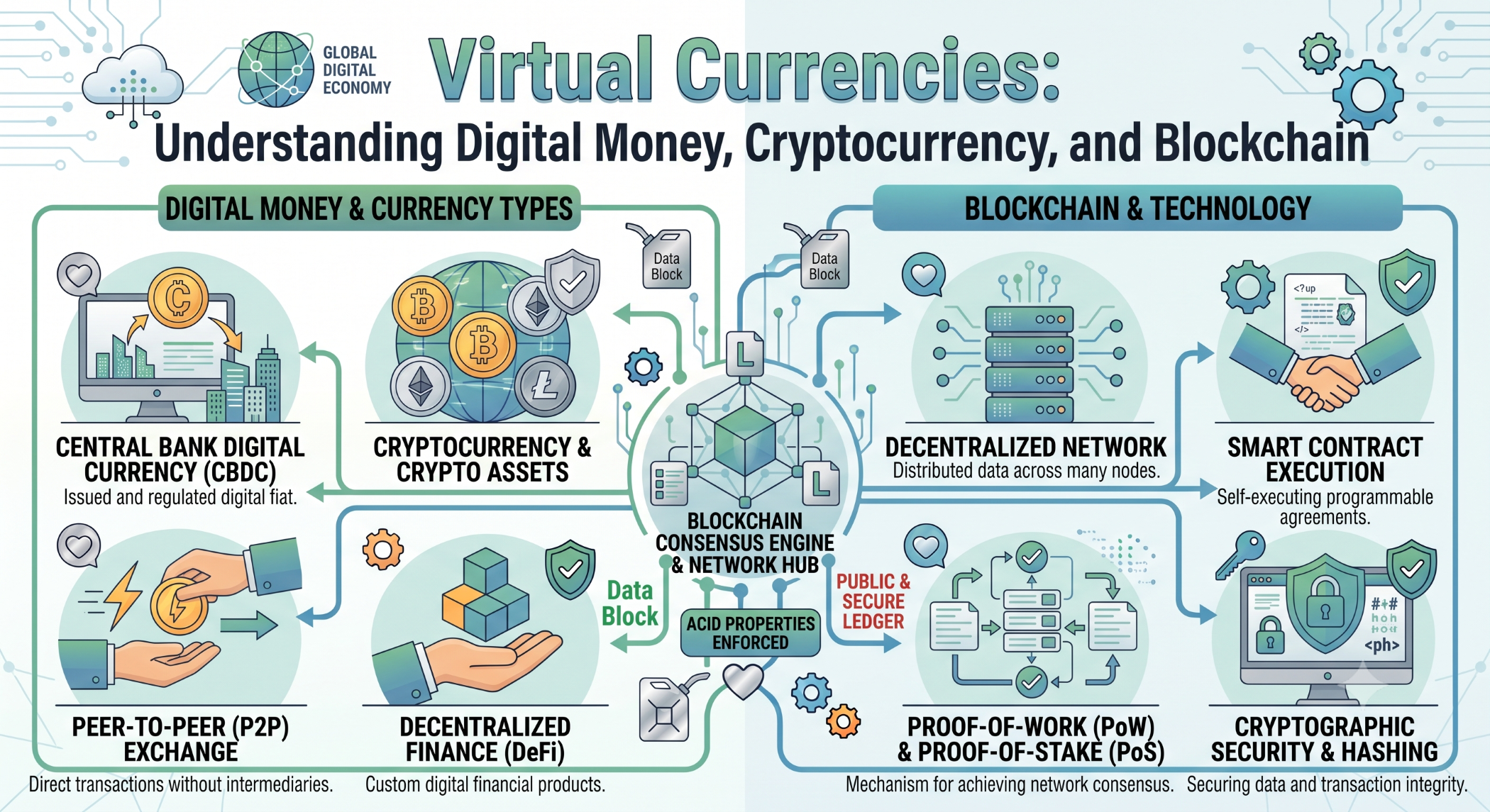
The term virtual currency covers a broader category than cryptocurrency. Cryptocurrencies such as Bitcoin use cryptography and decentralized blockchain networks, while some virtual currencies can be controlled by a central organization or platform.
As businesses become increasingly digital, virtual currencies and related technologies are influencing online payments, digital marketplaces, gaming ecosystems, financial services, and blockchain-based applications.
How Do Virtual Currencies Work?
Virtual currencies operate through digital systems that record ownership and transactions. Depending on the currency, these records may be maintained by a centralized organization or through a distributed network.
In a centralized virtual currency system, a company or administrator controls the ledger, establishes transaction rules, and may manage the issuance or redemption of the currency. Online platforms, loyalty systems, and some digital ecosystems can use this type of model.
Decentralized virtual currencies work differently. Blockchain networks distribute transaction records across participating computers and use cryptographic techniques and consensus mechanisms to validate transactions. This reduces the need for a single central administrator.
For example, when a blockchain transaction is submitted, the network verifies it according to its protocol before adding it to the shared ledger. Once confirmed, the transaction becomes part of the blockchain's historical record.
Types of Virtual Currencies
Virtual currencies can be classified in several ways based on how they are managed and used.
Centralized virtual currencies are administered by a particular company, platform, or organization. The administrator generally maintains the transaction ledger and defines how the currency can be used.
Decentralized virtual currencies operate without a single controlling authority. Cryptocurrencies are the most prominent example of this category.
Virtual currencies can also be convertible or non-convertible. Convertible currencies can be exchanged for traditional currencies or other digital assets through available markets, while non-convertible currencies are generally restricted to a particular platform or virtual environment.
Virtual Currency vs Cryptocurrency
Virtual currency and cryptocurrency are closely related terms, but they are not always interchangeable.
Cryptocurrency is a form of virtual or digital currency that relies on cryptographic techniques and, commonly, decentralized distributed-ledger technology. Bitcoin is a well-known example.
Virtual currency is the broader concept. It can include digital value systems that do not use blockchain technology and may be operated by a central organization. For example, a platform could create digital credits that can only be used within its own ecosystem.
This distinction is important for businesses evaluating digital payment systems or blockchain solutions. The underlying technology, level of decentralization, transaction model, and regulatory treatment can differ significantly.
Role of Blockchain in Virtual Currencies
Blockchain has become one of the most important technologies associated with decentralized virtual currencies.
A blockchain is a shared digital ledger in which transaction records are stored across a distributed network. Cryptographic techniques and consensus mechanisms help participants agree on the validity of transactions.
This model can provide several useful characteristics:
Transparency: Transaction records on many public blockchains can be independently inspected.
Security: Cryptographic mechanisms help protect transaction records and account ownership.
Decentralization: There may be no single organization responsible for maintaining the complete transaction history.
Traceability: Transactions can often be followed through the blockchain ledger.
These characteristics have also encouraged blockchain applications beyond currencies, including supply-chain systems, digital identity, financial infrastructure, and asset management.
Advantages of Virtual Currencies
Virtual currencies can provide several benefits when implemented appropriately.
Faster digital transactions: Digital value can be transferred electronically without relying on physical cash.
Global accessibility: Certain blockchain-based currencies can be transferred between users across geographic boundaries, subject to local regulations and network availability.
Programmable financial systems: Blockchain-based assets can be integrated into smart contracts and automated workflows.
Reduced dependence on intermediaries: Decentralized systems can enable peer-to-peer transactions without requiring every transaction to be processed by a traditional central intermediary.
New digital business models: Organizations can build marketplaces, gaming economies, loyalty systems, tokenized platforms, and other applications around digital assets.
Challenges and Risks
Virtual currencies also introduce important risks.
Price volatility: Market-based cryptocurrencies can experience substantial changes in value.
Security risks: Poor wallet management, compromised credentials, vulnerable applications, and fraudulent schemes can result in financial losses.
Regulatory uncertainty: The legal and regulatory treatment of virtual currencies varies by jurisdiction and can change over time.
Consumer protection: Unlike traditional bank deposits or government-issued currencies, certain virtual currencies may not have the same forms of institutional protection.
Fraud and misuse: Digital currencies can be exploited for scams, money laundering, and other illegal activities, making security, compliance, and responsible system design essential.
For businesses developing virtual-currency or blockchain applications, security architecture, authentication, transaction monitoring, compliance requirements, and data protection should be considered from the beginning.
Business Applications of Virtual Currencies
Virtual currencies can support a wide range of digital business models.
E-commerce platforms can experiment with alternative digital payment methods. Gaming companies can create virtual economies and digital rewards. Financial technology companies can build blockchain-powered transaction and settlement solutions. Enterprises can also investigate tokenization and distributed-ledger applications for specific business processes.
However, choosing a virtual-currency solution should start with the business requirement rather than the technology itself. A centralized digital-credit system may be more appropriate for one application, while a decentralized blockchain-based asset may be better suited to another.
The Future of Virtual Currencies
The broader digital-asset ecosystem continues to evolve. Virtual currencies are increasingly discussed alongside blockchain, stablecoins, tokenization, decentralized applications, and central bank digital currencies.
Businesses should therefore distinguish between virtual currency as a business concept and cryptocurrency as a specific technological implementation. Understanding this difference makes it easier to select an architecture that fits the required level of decentralization, security, scalability, transaction speed, and regulatory compliance.
Virtual currencies are not simply a replacement for traditional money. They represent a wider shift toward programmable and digitally native forms of value. As blockchain and financial technologies mature, their most valuable applications may extend well beyond simple payments.
How Solace Infotech Can Help
Developing a secure digital-currency, blockchain, or fintech application requires more than implementing a transaction system. It requires thoughtful architecture, secure APIs, authentication, data management, scalability, integration, and ongoing monitoring.
Solace Infotech can help businesses evaluate blockchain and digital-asset use cases and develop customized web and mobile applications around their specific requirements. From proof of concept to production deployment, the focus should remain on creating a secure, scalable, and practical solution that delivers measurable business value.