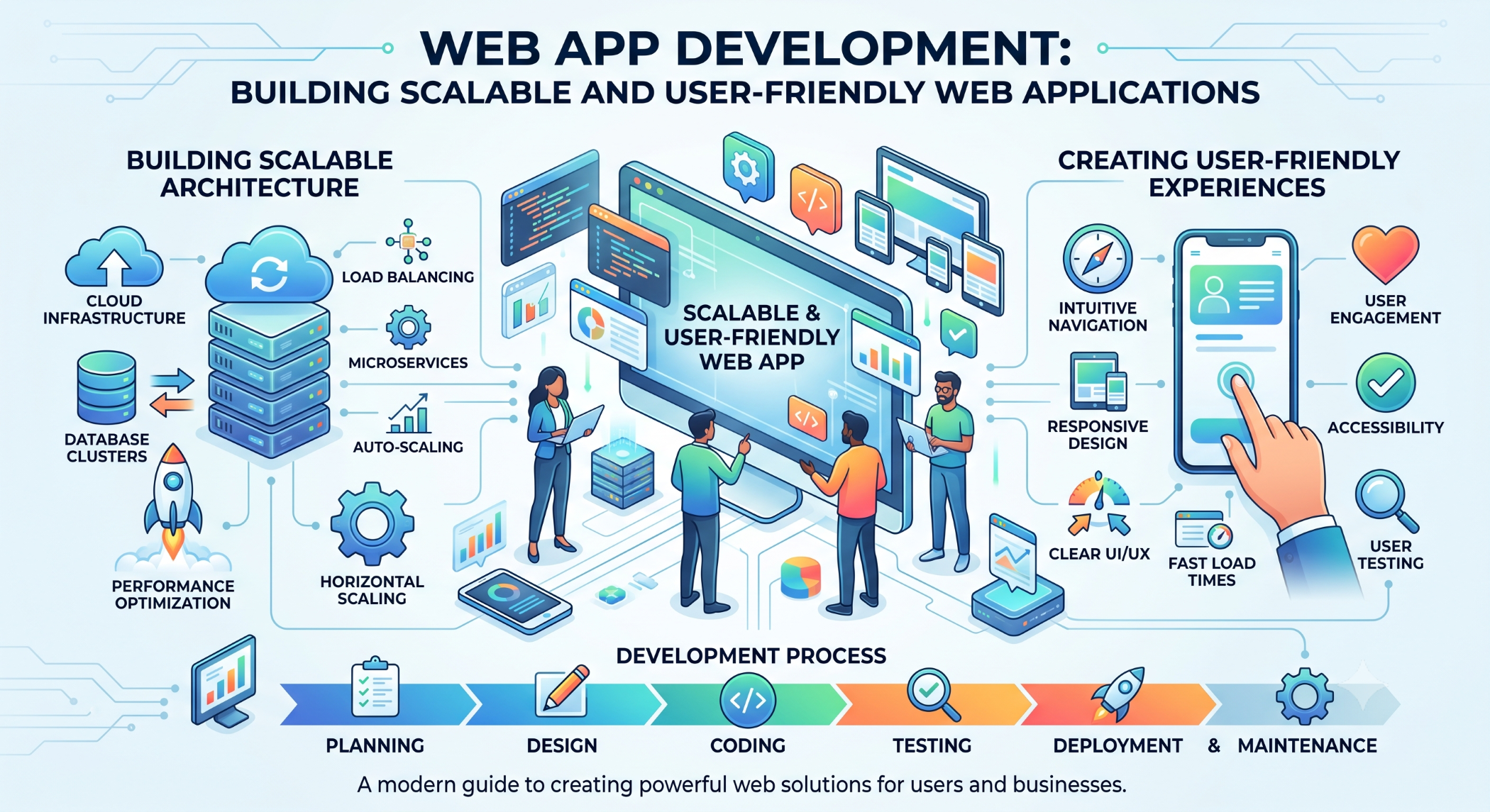
Web App Development: Building Scalable and User-Friendly Web Applications
Businesses increasingly rely on digital platforms to serve customers, automate processes, and manage operations. A web application provides an interactive experience through a web browser without requiring users to install traditional desktop software.
From customer portals and dashboards to e-commerce platforms and business management systems, web applications can support a wide range of business requirements.
What Is a Web App?
A web application is software that runs on a web server and is accessed through a browser.
Unlike a traditional static website, a web app typically allows users to interact with data and perform actions.
Examples include:
Online shopping platforms
Customer portals
Banking applications
Project management systems
Admin dashboards
Booking platforms
SaaS applications
How Does a Web Application Work?
A typical web application contains a frontend, backend, database, and supporting services.
User
↓
Web Browser
↓
Frontend
↓
Backend / API
↓
Database
The browser sends requests to the application server, the backend processes the request and interacts with required services or databases, and the resulting information is returned to the user.
Frontend Development
The frontend is the part of the application users see and interact with.
Common frontend technologies include:
HTML
CSS
JavaScript
Angular
React
Bootstrap
A good frontend should provide clear navigation, responsive layouts, consistent interactions, and fast performance.
Backend Development
The backend handles business logic, authentication, database operations, APIs, and other application functionality.
Technologies such as PHP, Laravel, CodeIgniter, Node.js, and Python can be used depending on project requirements.
The backend should be designed with security, scalability, maintainability, and performance in mind.
Database Integration
Most web applications need to store and retrieve information.
Databases such as MySQL can be used to manage users, products, transactions, content, and other application data.
Well-designed tables, appropriate indexes, and optimized queries can improve application performance as data volumes increase.
Benefits of Web Applications
Accessible From Any Device
A web application can be accessed through a compatible browser on desktops, tablets, and smartphones.
Easier Updates
Application updates can generally be deployed centrally on the server rather than requiring users to install a new version manually.
Cross-Platform Support
A well-designed responsive web application can serve users across multiple operating systems and devices.
Business Automation
Web applications can automate workflows such as order processing, reporting, customer management, approvals, and internal operations.
Web App Security
Security should be considered throughout development.
Important areas include:
Secure authentication
Authorization and access control
Input validation
HTTPS
Secure API design
Data protection
Dependency updates
Security measures should be appropriate for the type of information and functionality the application handles.
Web App Performance
Performance can be influenced by frontend code, backend processing, database queries, network latency, and infrastructure.
Developers can improve performance through techniques such as caching, database optimization, efficient APIs, optimized assets, and content delivery networks.
Performance should be measured before and after optimization to identify the actual bottlenecks.
Web App vs Website
A website primarily provides information to visitors.
A web application provides interactive functionality and usually allows users to create, modify, or manage data.
For example, a company website may display services and contact information, while a customer portal allows users to log in, manage profiles, submit requests, and view account information.
Web Application Development at Solace Infotech
Solace Infotech provides web development capabilities across technologies including PHP, Laravel, CodeIgniter, Angular, React, Node.js, MySQL, WordPress, Drupal, Magento, and OpenCart, supporting custom websites and web applications according to business requirements.
The appropriate technology stack is selected based on the application's functionality, integrations, scalability, performance, and long-term maintenance requirements.
Best Practices
Start with clear requirements and define the application's users, workflows, integrations, and scalability expectations before development.
Use modular architecture, maintain clean and reusable code, secure APIs and authentication, optimize database queries, and test the application across browsers and devices.
Continuous monitoring and maintenance are also important after deployment.
Conclusion
Web applications provide businesses with a flexible way to deliver interactive digital services through the browser. They can support everything from customer-facing portals and e-commerce platforms to internal business systems and SaaS products.
A successful web application combines good user experience, reliable architecture, strong security, efficient performance, and scalability.
The right development approach depends on the business problem being solved, the application's complexity, the target users, and the organization's long-term technology goals.