What Exactly Is Good PHP Performance?
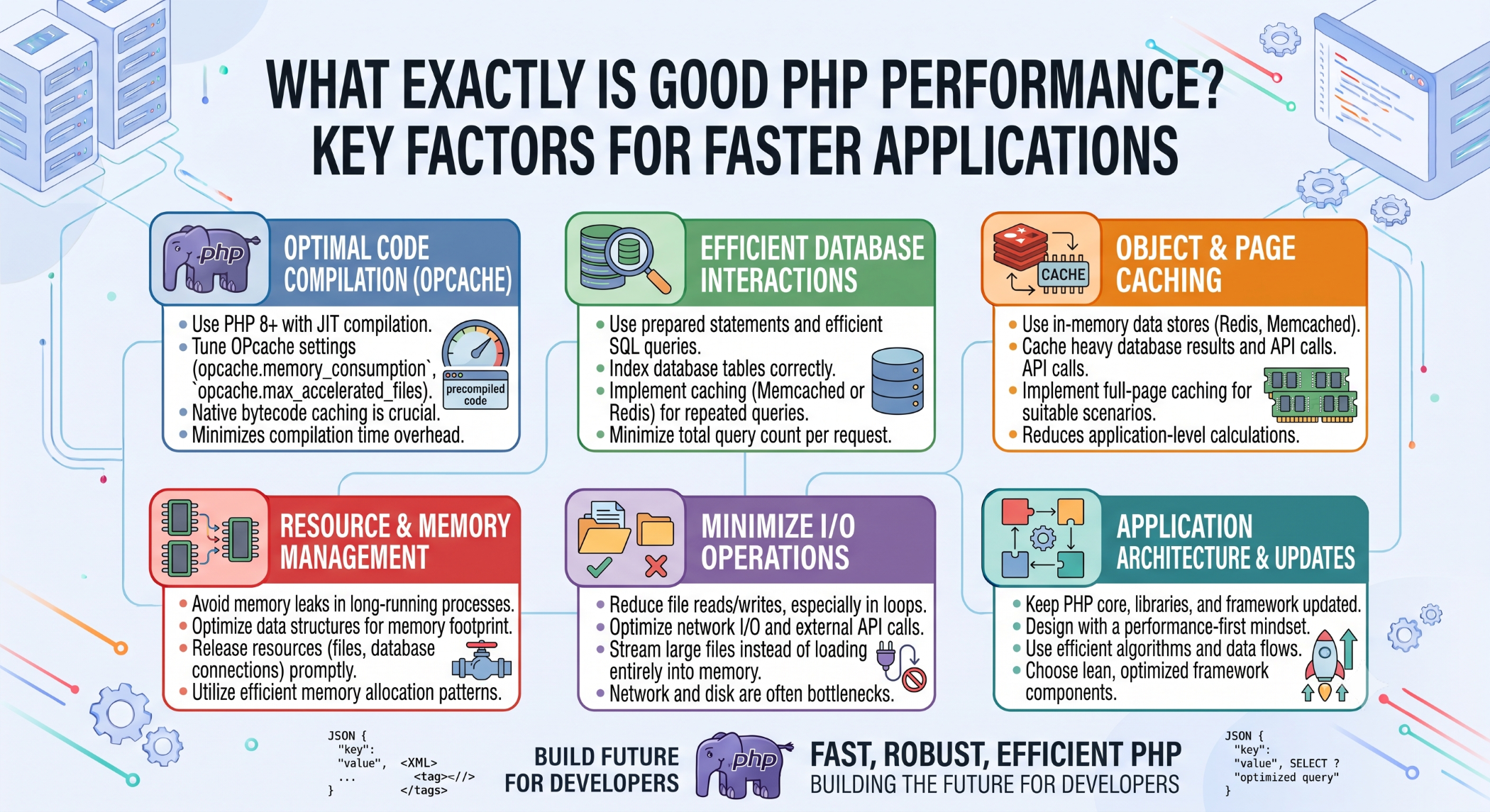
PHP performance is often discussed in terms of how quickly a page or API responds. However, good PHP performance is broader than response time alone.
A well-performing PHP application should respond quickly, use server resources efficiently, handle expected traffic reliably, and remain scalable as the application grows.
What Does Good PHP Performance Mean?
Good PHP performance means an application can complete its required operations efficiently without unnecessarily consuming CPU, memory, database, or network resources.
Important performance indicators include:
- Response time
- PHP execution time
- CPU usage
- Memory consumption
- Database query time
- External API latency
- Requests handled per second
These measurements help developers understand the actual performance of an application.
Fast Response Time
Users expect web applications to respond quickly.
A slow PHP script may result from inefficient code, slow database queries, external API calls, or excessive processing.
Improving response time requires identifying where the request spends most of its time rather than optimizing PHP syntax alone.
Efficient Database Queries
Database operations are frequently a major contributor to application latency.
Avoid unnecessary queries and retrieve only the information required.
SELECT id, name, email
FROM users
WHERE status = 'active';
Use suitable indexes and tools such as EXPLAIN to investigate query execution.
Effective Caching
Caching can reduce repeated processing and database requests.
Depending on the application, developers can cache frequently accessed data, API responses, expensive calculations, or rendered content.
A good caching strategy should also define how and when cached data is refreshed.
Efficient Memory Usage
A PHP application should avoid consuming excessive memory unnecessarily.
Large datasets should be processed carefully rather than loading everything into memory at once. Unnecessary object creation, large arrays, and inefficient processing can increase memory consumption.
Monitoring memory usage can help identify scripts that require optimization.
Use OPcache
PHP's OPcache can improve runtime performance by storing precompiled PHP bytecode in shared memory. This reduces the need to compile PHP scripts repeatedly.
For production environments, OPcache should be configured appropriately and monitored as part of the overall PHP performance strategy.
Minimize External API Delays
Modern applications often depend on payment gateways, third-party APIs, cloud services, and other external systems.
Even if PHP code executes quickly, a slow external request can increase the overall response time.
Use appropriate timeouts, caching, retry strategies, and asynchronous processing where suitable.
Scalability Matters
Good performance should not only apply when there are a few users.
A scalable PHP application should continue to perform reliably as traffic and data increase.
Depending on the application, scalability may involve:
Optimized PHP
      ↓
Caching
      ↓
Optimized Database
      ↓
Load Balancing
      ↓
Horizontal Scaling
The right architecture depends on actual workload requirements.
Measure Before Optimizing
One of the most important principles of PHP performance is to measure first.
Use profiling and monitoring tools to identify expensive operations. Optimize the bottleneck, then measure again to determine whether the change produced a meaningful improvement.
Avoid spending significant development effort optimizing code that has little impact on overall performance.
Performance and Maintainability
Highly optimized code is not useful if nobody can maintain it.
Developers should balance performance with readability, reliability, security, and maintainability. A small performance improvement is rarely worth introducing unnecessary complexity into the codebase.
Conclusion
So, what exactly is good PHP performance?
It is a combination of fast response times, efficient resource usage, optimized database operations, effective caching, reliable architecture, and the ability to handle increasing workloads.
The best-performing PHP applications are not necessarily those with the shortest code. They are applications where developers understand the workload, identify real bottlenecks, and continuously improve the system based on measurable results.