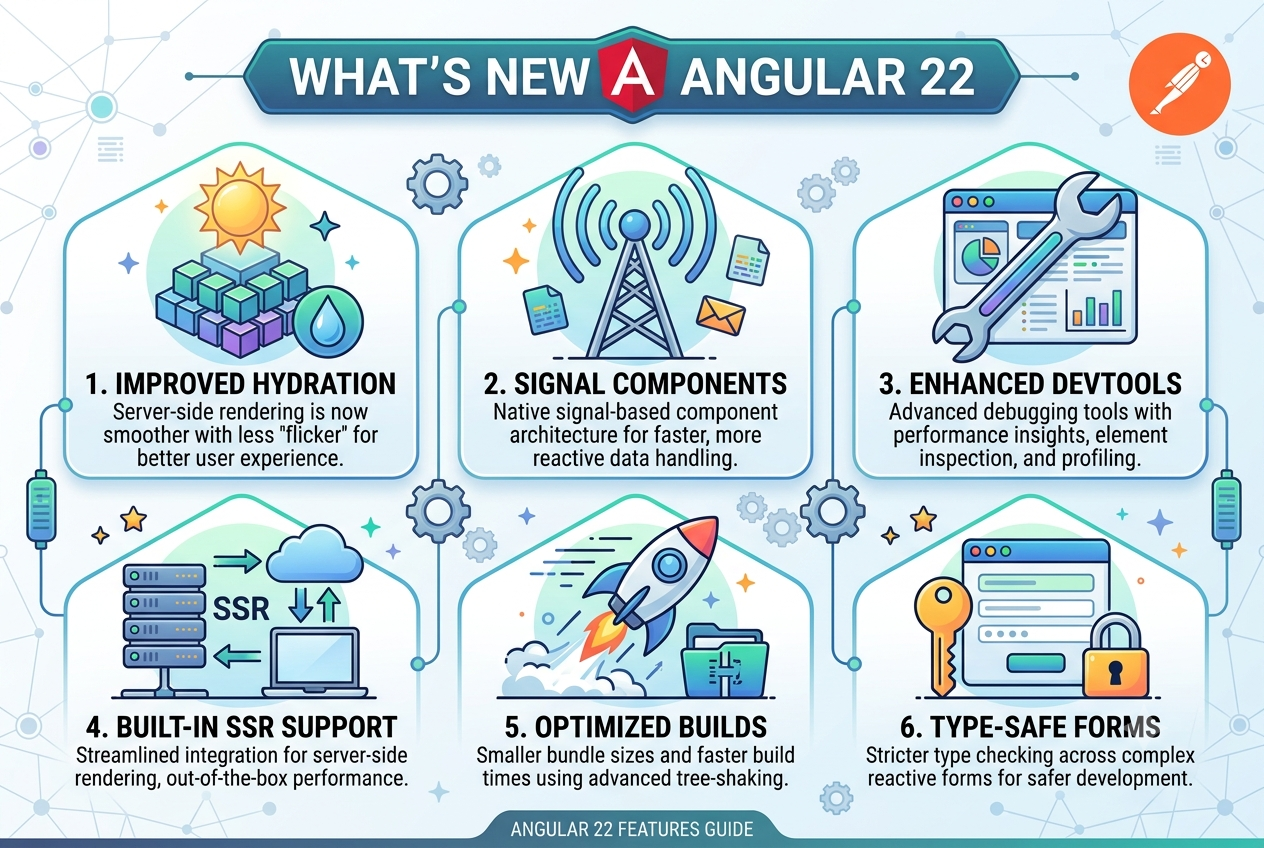
What's New In Angular 22
Angular has changed significantly since Angular 13. Modern Angular focuses on better performance, simpler application development, improved developer experience, and support for modern web development patterns.
Angular 22 is the current major release as of September 2026. Angular follows a regular release cycle, with major versions receiving approximately 24 months of support, including Active and Long-Term Support periods.
The latest Angular ecosystem also includes stable capabilities such as zoneless change detection, Signal Forms, Resource APIs, incremental hydration, route-level rendering, and improved developer tooling.
Let's explore the major developments in modern Angular and what developers should know when moving beyond Angular 13.
1. Modern Angular Uses Signals
One of the biggest changes since Angular 13 is the introduction and evolution of Signals.
Signals provide a reactive way to represent and track application state. Instead of relying exclusively on traditional change-detection patterns, developers can use signals to create more precise reactive relationships between application data and the UI.
Modern Angular includes APIs such as:
signal()
computed()
effect()
linkedSignal()
resource()
httpResource()
The Angular roadmap identifies these modern reactive APIs as part of the framework's current direction.
Signals can be particularly useful in applications with complex state management and frequent UI updates.
2. Zoneless Change Detection
Another major evolution is zoneless Angular.
Traditional Angular applications commonly relied on Zone.js to detect asynchronous activity and determine when the UI should be updated.
Modern Angular provides zoneless change detection, allowing applications to operate without Zone.js.
Angular's roadmap lists zoneless change detection as production-ready and describes it as an important performance and interoperability improvement.
For larger applications, reducing unnecessary change-detection work can help improve performance and simplify debugging.
3. Signal Forms
Forms are a major part of most business applications, and Angular has introduced a modern signal-based approach to forms.
Signal Forms provide a reactive way to manage form state using signals.
This can make complex forms easier to reason about while providing a modern approach to validation and state management.
Angular's current roadmap identifies Signal Forms as a stable capability and notes that they can interoperate with existing reactive forms, allowing teams to migrate progressively.
This is particularly useful for enterprise applications containing large forms and multi-step workflows.
4. Resource API And httpResource
Modern Angular provides APIs designed to simplify asynchronous data management.
The resource() API provides a reactive approach to asynchronous state, while httpResource() provides a similar pattern specifically for HTTP-based data.
These APIs can reduce some of the boilerplate traditionally associated with loading, error, and asynchronous state management.
Angular identifies Resource API and httpResource among its modern production-ready or recently stabilized capabilities.
5. Better Server-Side Rendering And Hydration
Angular continues to improve server-side rendering and hybrid rendering.
Modern Angular applications can combine server rendering with client-side hydration to improve the initial experience while retaining application interactivity.
Features such as incremental hydration allow developers to control when parts of an application become interactive.
This can be particularly valuable for:
Content-heavy websites
eCommerce applications
Enterprise portals
Marketing websites
Large dashboards
Applications where initial loading performance matters
Angular lists incremental hydration and event replay with SSR among its production-ready capabilities.
6. Deferrable Views
Angular introduced deferrable views to make it easier to load parts of an application only when they are needed.
Developers can defer components or sections that are not immediately required by the user.
This can reduce the amount of JavaScript that needs to be loaded during the initial application startup.
For example, a large dashboard might initially load the main navigation and summary information while deferring less frequently used reports until the user opens them.
Angular's roadmap notes that deferrable views were introduced experimentally in Angular 17 and subsequently became stable.
7. Improved Build System
Modern Angular has moved toward a newer build pipeline based around modern tooling such as esbuild and Vite.
This represents a significant change from the tooling developers commonly used with older Angular versions.
The newer build system can improve:
Build speed
Development feedback
Hot module replacement
Production bundling
Developer productivity
Angular's roadmap notes that the Vite/esbuild-based application builder became the default for new projects and delivered substantial build-time improvements for hybrid rendering projects.
8. Improved Hot Module Replacement
Hot Module Replacement, or HMR, improves the development experience by allowing developers to update parts of an application without performing a complete page reload.
Modern Angular has progressively expanded HMR support.
Angular reports that template HMR became stable in Angular 20, continuing the framework's focus on faster development workflows.
For development teams working on large applications, faster feedback cycles can save significant development time.
9. Improved Testing With Vitest
Angular has also modernized its testing ecosystem.
According to the Angular roadmap, Vitest is now the primary test runner following its stable release in Angular 21.
Angular is also working on migration tooling to help existing applications move from Karma to Vitest.
This gives developers a modern testing workflow while helping existing projects gradually transition from older testing infrastructure.
10. Angular Aria For Accessible Components
Accessibility has become an increasingly important part of modern web application development.
Angular introduced Angular Aria, a collection of headless accessibility-focused interaction patterns.
The approach separates interaction behavior from visual styling, allowing developers to create components that fit their own design systems.
Angular introduced Angular Aria in developer preview in Angular 21, and according to the current roadmap it was promoted to stable in Angular 22.
This allows teams to build accessible interfaces while retaining control over the visual design.
11. Better AI-Assisted Development
Modern Angular is also responding to the growth of AI-assisted software development.
Angular 21 introduced new tooling around AI-powered development workflows, including Angular MCP Server capabilities designed to improve AI-assisted development and code generation.
Angular's roadmap identifies improving the AI experience for developers as one of its current strategic goals.
The framework is exploring integrations with tools such as Google AI Studio, Gemini CLI, agentic development environments, MCP capabilities, and AI SDKs.
For development teams, this means Angular is increasingly being designed to work alongside modern AI-assisted development workflows.
12. Improved Application Performance
Performance remains one of Angular's major priorities.
Modern Angular provides multiple mechanisms that can help developers optimize applications:
Signals
Zoneless change detection
Deferrable views
Incremental hydration
Improved build tooling
Lazy loading
Server-side rendering
Better reactivity
Instead of relying on a single optimization technique, developers can combine these capabilities depending on the application's requirements.
13. Modern Angular Application Architecture
Angular 13 applications were commonly structured around NgModules.
Modern Angular supports a more streamlined application architecture using standalone components and related APIs.
Standalone components reduce the need for NgModule-based organization and can make application dependencies easier to understand.
This is particularly useful when building new applications or gradually modernizing older Angular codebases.
For businesses maintaining older Angular applications, modernization should generally be planned incrementally rather than attempting to rewrite the entire application at once.
14. Improved Developer Experience
Angular's recent development has focused heavily on reducing unnecessary complexity.
Modern Angular provides improvements across:
Application creation
Build tooling
Component development
Reactive state
Testing
Server-side rendering
Debugging
AI-assisted development
Accessibility
The overall direction is toward helping developers spend less time managing framework infrastructure and more time implementing application functionality.
Angular 13 Vs Modern Angular
Angular 13 was released several years ago and represented an important stage in Angular's evolution. However, the framework has changed considerably since then.
Some of the major differences include:
Angular 13:
NgModule-oriented architecture
Traditional change detection
Zone.js-centric workflows
Older build tooling
Traditional reactive patterns
Older testing ecosystem
Modern Angular:
Standalone application architecture
Signals and modern reactivity
Zoneless change detection
Deferrable views
Modern SSR and hydration
Vite/esbuild-based tooling
Vitest testing
Signal Forms
Resource APIs
Angular Aria
AI-assisted development tooling
These changes make modern Angular substantially different from the Angular 13 development experience.
Should You Upgrade An Angular 13 Application?
If your business is still running an Angular 13 application, upgrading should be considered as part of a broader application modernization strategy.
Angular's official support documentation states that versions 2 through 19 are no longer supported, while Angular 20, 21, and 22 are within the current support schedule.
An upgrade can provide access to:
Security updates
Supported dependencies
Modern browser compatibility
Improved build performance
Modern Angular APIs
Better development tooling
Performance improvements
New framework capabilities
However, an upgrade should be properly tested because major Angular versions can include breaking changes.
Angular recommends using ng update and following its incremental upgrade approach. When moving across multiple major versions, Angular recommends upgrading one major version at a time rather than jumping across several unsupported transitions in a single step.
Best Practices For Modern Angular Development
When developing or modernizing an Angular application, consider the following practices:
Use Standalone Components
Prefer the modern standalone architecture for new development where appropriate.
Adopt Signals Where They Add Value
Use signals for reactive state rather than automatically introducing them everywhere.
Consider Zoneless Architecture
For new applications, evaluate zoneless change detection based on your application's dependencies and requirements.
Optimize Initial Loading
Use lazy loading, deferrable views, SSR, and hydration strategies where they provide measurable benefits.
Keep Dependencies Updated
Regularly review Angular, TypeScript, Node.js, and third-party dependencies.
Automate Testing
Use unit, integration, and end-to-end testing to reduce regression risk during upgrades.
Monitor Application Performance
Use real-world performance and error monitoring instead of relying only on local development testing.
Plan Angular Upgrades Regularly
Regular incremental upgrades are generally easier to manage than allowing an application to remain several major versions behind.
Why Modern Angular Matters For Businesses
For businesses, Angular's evolution is not simply about having a newer framework version.
Modern Angular can help development teams work with:
More maintainable application architecture
Improved application performance
Modern web rendering techniques
Better developer productivity
Stronger testing workflows
Improved accessibility
Modern AI-assisted development
Long-term framework support
This can be particularly valuable for enterprise applications where the application may need to be maintained and enhanced for many years.
Conclusion
Angular has evolved significantly since Angular 13. Modern Angular focuses on performance, simpler architecture, reactive development, better rendering, modern tooling, accessibility, testing, and AI-assisted development.
Angular 22 represents the current major generation of the framework, while features such as Signals, Signal Forms, zoneless change detection, Resource APIs, incremental hydration, deferrable views, Vitest, and Angular Aria demonstrate how much the platform has progressed.
For organizations still using Angular 13, the upgrade conversation should focus not only on version compatibility but also on modernization opportunities, technical debt, application performance, security, and long-term maintainability.