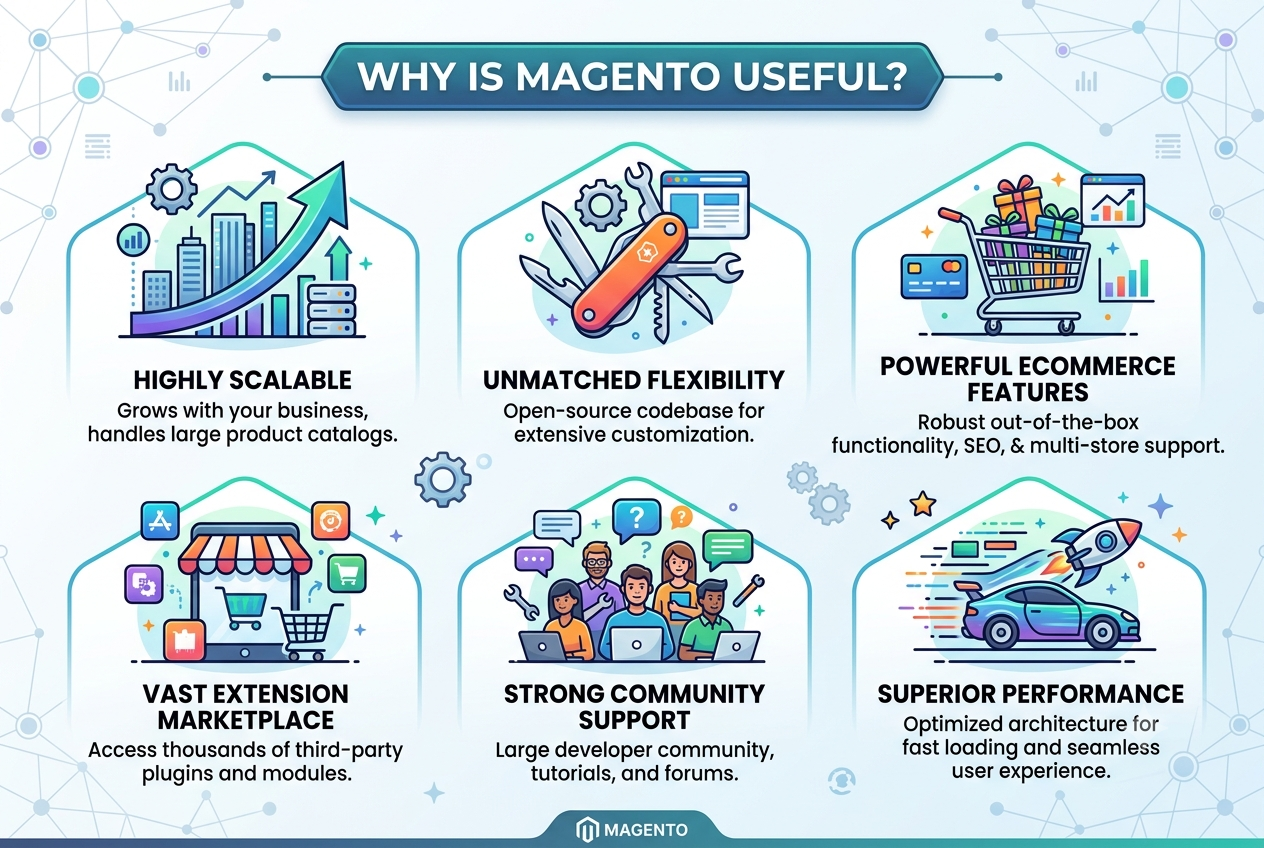
Why Is Magento Useful
Magento, now known through Magento Open Source and Adobe Commerce, is a flexible eCommerce platform designed for businesses that need more control over their online stores. It provides capabilities for catalog management, customer accounts, checkout, payments, inventory, multiple storefronts, promotions, and integrations.
For businesses with complex product catalogs, multiple markets, B2B requirements, or customized purchasing workflows, Magento can provide a strong foundation for building and managing an eCommerce operation.
What Makes Magento Useful For eCommerce?
Magento is useful because it combines core eCommerce functionality with extensive customization options. Businesses can configure their store structure, products, pricing, customer groups, checkout, shipping, and other commerce processes according to their requirements.
Some of its important advantages include:
Flexible store management
Advanced catalog management
Multiple websites and store views
Customizable checkout
Multiple payment and shipping options
Inventory management
SEO capabilities
Customer segmentation
Promotions and pricing rules
B2B commerce functionality
API-based integrations
1. Flexible Product Catalog Management
Product and catalog management is one of the most important parts of any eCommerce platform.
Magento provides tools for creating and managing products, categories, attributes, pricing, and inventory. Its catalog architecture can support businesses ranging from a single online store to organizations managing multiple stores and inventory locations.
This makes Magento useful for businesses with:
Large product catalogs
Multiple product categories
Configurable products
Different product attributes
Multiple warehouses
Different pricing structures
2. Multiple Websites And Store Views
Magento allows businesses to manage multiple websites, stores, and store views from a single installation.
This can be useful for businesses operating in different:
Countries
Languages
Currencies
Brands
Product categories
Customer segments
A business can therefore create different storefront experiences while maintaining centralized management of important commerce operations.
3. Extensive Customization
Every business has different requirements. A standard eCommerce template may not always provide the functionality required by a growing organization.
Magento provides a flexible foundation for customizing:
Storefronts
Product catalogs
Checkout workflows
Customer accounts
Pricing rules
Promotions
Payment methods
Shipping processes
Backend workflows
Third-party integrations
This flexibility makes Magento particularly useful when an organization requires functionality beyond a basic online store.
4. Powerful eCommerce Features
Magento includes many capabilities required to operate an online store.
These include:
Shopping cart
Checkout
Customer accounts
Product search
Product reviews
Wish lists
Promotions
Coupons
Order management
Invoicing
Shipping
Returns
Payment management
Merchants can manage orders, invoices, shipments, transactions, and other purchasing activities through the administration system.
5. Strong B2B Capabilities
Magento is also useful for businesses selling to other businesses.
Adobe Commerce provides B2B functionality such as:
Company accounts
Buyer roles
Purchase approval workflows
Shared catalogs
Negotiable quotes
Quick orders
Customer-specific pricing
These capabilities can help businesses manage more complex purchasing relationships than a standard consumer-focused online store.
6. SEO-Friendly eCommerce Features
Search visibility is important for online businesses. Magento provides built-in capabilities that support SEO, including:
Custom URLs
Metadata
XML sitemap support
Search-friendly product and category pages
Canonical URL configuration
SEO-oriented catalog management
Businesses can use these capabilities to create more search-engine-friendly storefronts and product pages.
7. Advanced Promotions And Pricing Rules
Magento allows merchants to create different pricing and promotional strategies.
Businesses can configure rules for:
Product discounts
Cart discounts
Coupons
Customer groups
Product combinations
Promotional campaigns
Targeted offers
Adobe Commerce also provides customer segmentation capabilities that can be used to create more personalized shopping experiences.
8. Inventory Management
Managing inventory becomes increasingly complicated as businesses add products, warehouses, stores, and fulfillment locations.
Magento provides inventory management capabilities that can support multiple sources and locations. Businesses can manage product quantities and coordinate inventory with order fulfillment processes.
This can be particularly useful for businesses operating:
Multiple warehouses
Physical stores
Pickup locations
Drop-shipping operations
Multiple fulfillment centers
9. Integration Capabilities
Modern eCommerce businesses rarely operate through a single system.
Magento can be integrated with external platforms and services such as:
Payment gateways
ERP systems
CRM platforms
Shipping providers
Accounting systems
Marketing platforms
Analytics tools
Customer support systems
Inventory management systems
Adobe Commerce also provides APIs and developer tools that support custom integrations and extensions.
10. Personalization And Product Recommendations
Personalized shopping experiences can help businesses present more relevant products and offers to customers.
Adobe Commerce provides capabilities such as customer segmentation, targeted promotions, product recommendations, and AI-powered search and merchandising services.
These capabilities can help businesses improve product discovery and create more relevant shopping experiences.
11. Scalability For Growing Businesses
Magento can support businesses as their product catalogs, traffic, orders, and operational requirements grow.
Modern Adobe Commerce offerings provide scalable infrastructure and services designed to support high-volume commerce operations. Adobe Commerce as a Cloud Service, for example, is designed to automatically adjust resources for changing traffic, order, and catalog demands.
However, scalability still depends on proper architecture, hosting, caching, database configuration, code quality, and ongoing performance optimization.
12. Better Control Over The Customer Experience
Magento gives businesses substantial control over their storefront and purchasing experience.
Organizations can customize:
Navigation
Product pages
Search
Shopping cart
Checkout
Customer accounts
Promotions
Content
Store layouts
This flexibility allows businesses to create shopping experiences around their specific products and customer journeys rather than being limited to a fixed storefront structure.
When Is Magento A Good Choice?
Magento can be particularly useful when a business requires:
A large or complex product catalog
Multiple websites or storefronts
International eCommerce operations
B2B and B2C commerce
Custom business rules
Advanced integrations
Multiple inventory locations
Personalized shopping experiences
Flexible pricing and promotions
Long-term platform customization
For a small business with a simple catalog and limited requirements, a simpler hosted eCommerce platform may require less technical management.
Magento Open Source Vs Adobe Commerce
Magento Open Source provides the core platform for businesses that want an open-source commerce solution.
Adobe Commerce builds on the Magento ecosystem with additional capabilities for areas such as B2B commerce, advanced merchandising, analytics, customer segmentation, and enterprise commerce operations. Adobe's current documentation distinguishes features that are exclusive to Adobe Commerce from those available in the Magento Open Source code base.
The appropriate edition depends on business requirements, budget, operational complexity, and the features needed.
Conclusion
Magento is useful because it provides businesses with a flexible foundation for building and managing sophisticated eCommerce operations. Its catalog management, multiple-store capabilities, customization options, inventory management, promotions, integrations, SEO features, and B2B functionality make it suitable for businesses with more complex requirements.
The platform should not be selected simply because it offers many features. Businesses should evaluate their catalog size, technical capabilities, budget, integrations, expected growth, and long-term maintenance requirements before choosing Magento.
For organizations that need a highly customizable and scalable eCommerce platform, Magento can provide the technical foundation needed to build a commerce experience around their specific business processes.