Introduction
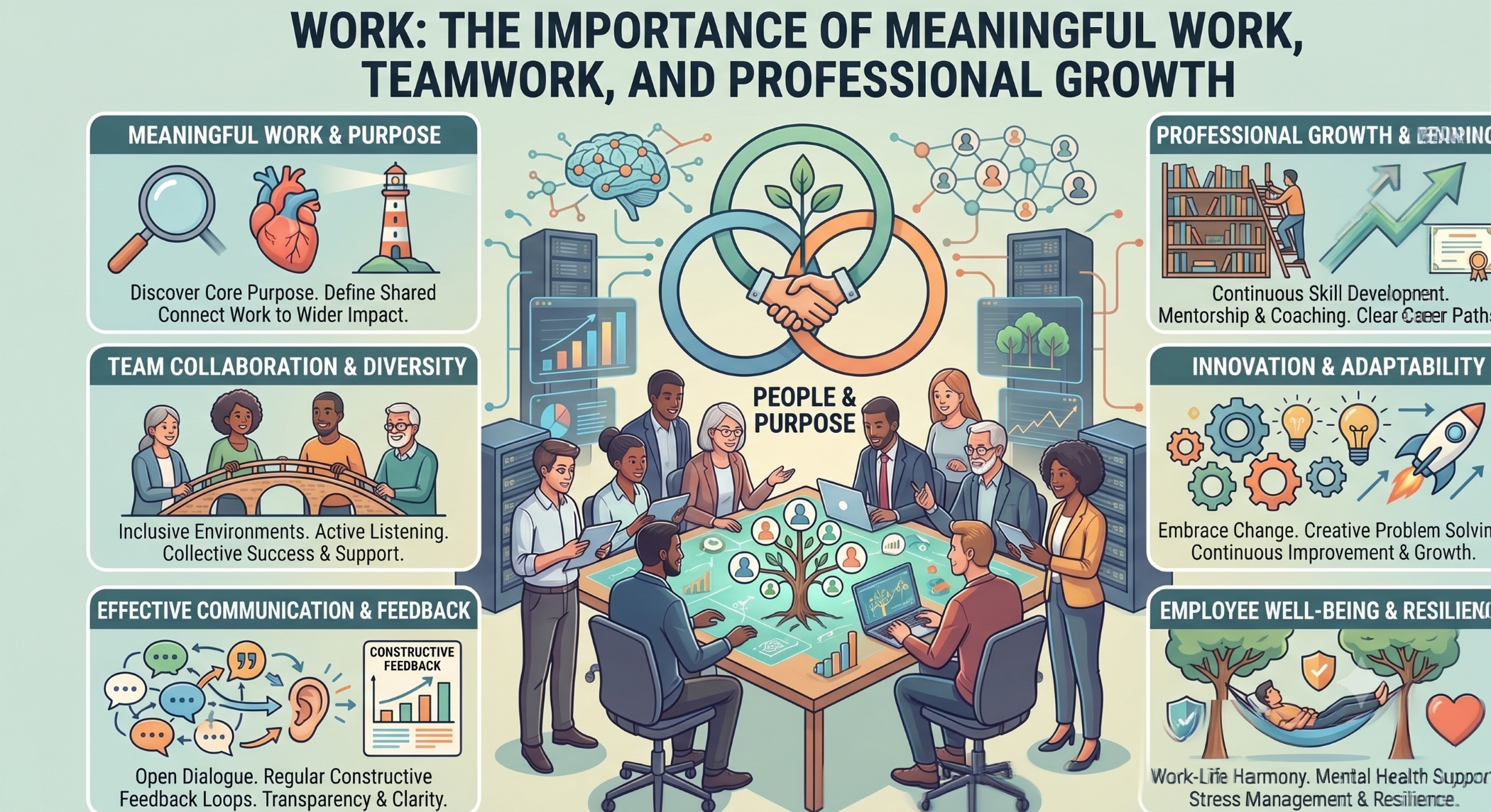
Work is an important part of our daily lives. It provides opportunities to use our skills, solve problems, learn from experience, support others, and contribute to something meaningful.
In a professional environment, work is not simply about completing a list of tasks. The quality of work, the attitude toward responsibilities, the ability to collaborate, and the willingness to learn all influence individual and organizational success.
For technology professionals, this is particularly important because software development requires continuous problem-solving, adaptation, communication, and teamwork.
What Does Work Mean in a Professional Environment?
Professional work is the process of using knowledge, skills, time, and resources to achieve a defined objective.
The objective may be developing software, serving customers, managing projects, improving business processes, selling products, maintaining infrastructure, or creating new products.
Good work focuses on outcomes rather than activity alone.
Being busy throughout the day does not necessarily mean that meaningful progress is being made. Effective work should contribute to a clearly understood goal.
The Importance of Taking Work Seriously
A professional approach to work means understanding that every responsibility can affect other people and the organization.
A delayed task may block another team. An incorrect implementation may create additional testing work. Poor communication may result in misunderstandings with a customer.
Taking responsibility for the quality and outcome of work helps reduce these problems.
Professionalism also means being dependable, meeting commitments, and communicating honestly when circumstances change.
Work and Responsibility
Responsibility is an essential part of professional work.
When a person accepts responsibility for a task, they should understand the expected outcome, available resources, dependencies, and deadline.
Responsibility also means raising concerns when something cannot be completed as expected.
For example, a developer who discovers a technical dependency that could delay a feature should communicate it early rather than waiting until the deadline arrives.
Responsible communication allows the team to adjust plans before a problem becomes larger.
Work and Accountability
Responsibility and accountability are closely connected.
Responsibility describes the work assigned to a person, while accountability involves owning the outcome.
A professional should not simply say, “I completed my task.” They should also consider whether the resulting work actually meets the intended requirement.
This distinction is particularly important in software development, where a feature may be technically implemented but still fail to satisfy the user's actual needs.
Meaningful Work
People often find greater satisfaction in work when they understand its purpose.
A developer may feel more connected to a project when they understand how the application helps customers. A support professional may be more motivated when they see how resolving an issue improves the user's experience.
Meaningful work connects individual effort with a larger outcome.
This does not mean every task will be exciting. Routine responsibilities are part of every profession. The important point is understanding how those responsibilities contribute to the larger objective.
Work and Passion
Passion can make work more engaging.
A person who enjoys technology may spend additional time exploring a framework, experimenting with a solution, or understanding why a system behaves in a particular way.
However, passion should be supported by discipline.
Professional work also requires documentation, testing, communication, planning, maintenance, and other responsibilities that may not always be exciting.
Passion provides enthusiasm, while discipline and consistency help turn that enthusiasm into dependable results.
Work and Concentration
Concentration is essential when performing complex work.
Software development, architecture, analysis, writing, design, and problem-solving often require uninterrupted attention.
Frequent notifications, unnecessary meetings, and constant task switching can make concentrated work more difficult.
Professionals can improve productivity by creating focused periods for important tasks and managing interruptions deliberately.
Work and Time Management
Every professional has limited time.
Effective time management helps ensure that important activities receive the attention they require.
Prioritizing tasks, planning the day, estimating effort, setting realistic deadlines, and reviewing progress can improve productivity.
Time management should not simply be about completing more tasks. It should focus on completing the right tasks with the appropriate level of quality.
Work and Teamwork
Most modern work is collaborative.
A software project may involve developers, testers, designers, project managers, business analysts, DevOps engineers, and clients.
Each person has a different responsibility, but the final outcome is shared.
Teamwork requires communication, respect, knowledge sharing, and an understanding of dependencies.
A strong team member does not focus only on individual tasks. They also consider how their work affects everyone else.
Work and Communication
Clear communication is essential for successful work.
Professionals should communicate requirements, progress, blockers, changes, and risks accurately.
For example, saying “Everything is fine” when a critical dependency remains unresolved creates false confidence.
Transparent communication may sometimes involve difficult conversations, but it allows teams and customers to make informed decisions.
Work and Problem Solving
Problems are inevitable.
Software may fail, requirements may change, customers may raise concerns, and deadlines may become difficult to achieve.
Effective professionals do not expect every workday to be free of problems.
Instead, they develop the ability to identify issues, analyze their causes, consider alternatives, and implement practical solutions.
Problem-solving turns unexpected challenges into opportunities for improvement.
Learning Through Work
One of the greatest benefits of professional work is the opportunity to learn through experience.
A project can teach skills that are difficult to develop through theory alone.
A developer may learn about application architecture by solving a production issue. A project manager may improve planning skills by managing complex dependencies. A business professional may better understand customer behavior through direct interactions.
Every project can therefore become a learning opportunity when people reflect on what worked and what did not.
Work and Continuous Learning
Technology professionals cannot depend only on the knowledge they already have.
New technologies, frameworks, tools, security practices, and business requirements appear continuously.
Continuous learning helps professionals remain adaptable.
Learning can happen through training, documentation, mentoring, experimentation, technical discussions, online resources, and practical projects.
The most valuable learning occurs when new knowledge is applied to real situations.
Work and Quality
Completing work quickly does not automatically mean completing it well.
Quality is an important part of professional responsibility.
In software development, quality can involve functionality, performance, security, usability, maintainability, and reliability.
A rushed implementation that creates repeated defects may require more time overall than a thoughtful implementation completed correctly.
Quality should therefore be considered throughout the work rather than only at the end.
Work and Innovation
Work can also be an opportunity to improve existing processes.
Innovation does not always mean creating something completely new. It can involve simplifying a workflow, automating a repetitive task, improving an application's performance, or finding a better way to serve customers.
Professionals who question inefficient processes and suggest practical improvements can create value beyond their assigned responsibilities.
Work and Leadership
Leadership is not restricted to managers.
A professional can demonstrate leadership by taking ownership, helping colleagues, sharing knowledge, communicating clearly, and making responsible decisions.
Employees who consistently demonstrate these behaviors may gradually take on broader responsibilities.
Leadership often develops through everyday work rather than through a title alone.
Work and Workplace Culture
The way people work contributes to company culture.
A culture of accountability encourages people to own their responsibilities. A collaborative culture encourages knowledge sharing. A learning-oriented culture encourages employees to develop new skills.
Culture is therefore created through repeated behaviors.
Organizations can support healthy workplace cultures by establishing clear expectations, encouraging communication, recognizing contributions, and giving people opportunities to grow.
Work and Customer Value
Businesses ultimately depend on the value they create for customers.
Technology teams should understand how their work affects the customer experience.
A feature that functions technically but creates confusion for users may still represent a poor outcome.
Professionals should therefore consider not only whether the task is complete, but whether it solves the intended problem effectively.
Work and Professional Growth
Every responsibility can contribute to career development.
Employees can use projects to strengthen technical expertise, communication, leadership, analytical thinking, and business understanding.
Taking on progressively greater responsibility can create opportunities for advancement.
Professional growth is usually a result of accumulated experience rather than one single achievement.
Work and Failure
Not every project or decision will produce the desired result.
A feature may fail testing. A proposal may be rejected. A new process may not produce expected improvements.
The important part is how the organization responds.
Reviewing failures objectively can reveal useful lessons about planning, communication, estimation, technology, and decision-making.
A workplace that learns from mistakes becomes better prepared for future challenges.
Work-Life Balance
Professional commitment is important, but sustainable performance also requires appropriate balance.
Working continuously without sufficient recovery can affect concentration, decision-making, and overall effectiveness.
Organizations and employees should therefore focus on sustainable productivity rather than equating long working hours with successful work.
Effective planning, prioritization, delegation, and realistic expectations can help maintain a healthier balance.
The Role of Managers
Managers influence the quality of work by providing clarity and support.
Employees need to understand priorities, expected outcomes, deadlines, and responsibilities.
Managers should also identify obstacles and help teams resolve dependencies.
A good manager does not simply assign more work. They help the team focus on the most important work and create conditions for successful execution.
Building Better Work Habits
Improving the way you work starts with small habits.
Begin with clear priorities.
Plan important work before distractions take over the day.
Communicate blockers early.
Document important decisions.
Review completed work and identify opportunities for improvement.
Keep learning.
Take ownership of outcomes rather than focusing only on assigned tasks.
These practices can gradually create a more effective professional approach to work.
Work in the Technology Industry
Technology work is particularly dynamic.
Employees may work with multiple clients, changing requirements, unfamiliar technologies, distributed teams, and demanding delivery schedules.
Adaptability is therefore an important professional skill.
A strong technology professional combines technical knowledge with problem-solving, communication, teamwork, accountability, and continuous learning.
Conclusion
Work is more than completing tasks. It is an opportunity to create value, develop skills, solve problems, and contribute to something larger than an individual responsibility.
Good work requires a combination of knowledge, concentration, accountability, collaboration, communication, and continuous improvement.
Whether you are developing software, managing projects, supporting customers, or leading a business, the way you approach your work influences both your own growth and the success of the people around you.
When professionals focus on meaningful outcomes, take ownership, continue learning, and work effectively with others, work becomes more than an obligation. It becomes a foundation for professional development and organizational success.