📌 Introduction
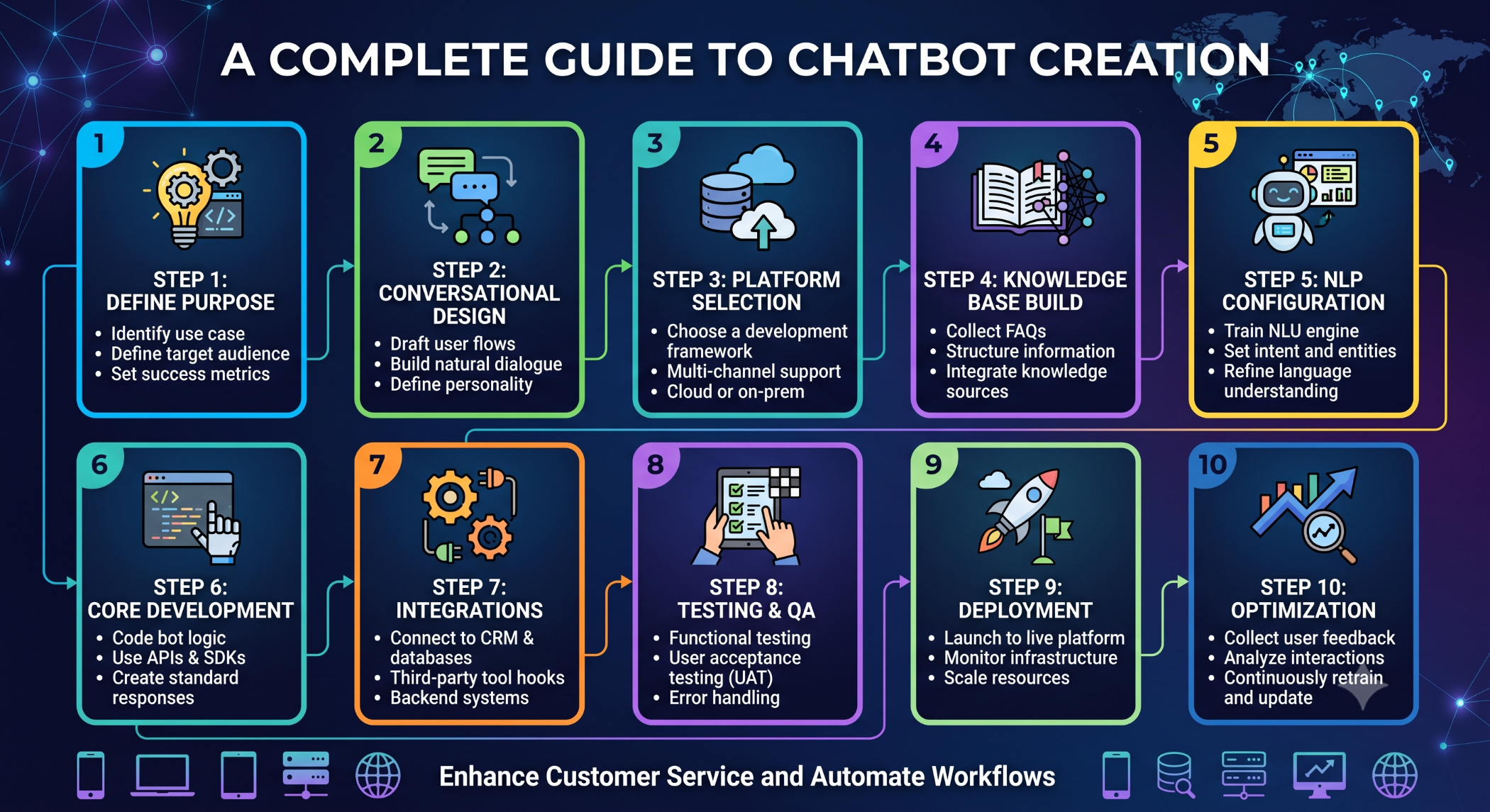
Chatbots have become a key interface for customer support, lead generation, and user engagement. When built correctly, they save time, boost satisfaction, and automate routine tasks. In this guide, we’ll cover everything from initial planning to deployment and optimization.
1. Planning & Strategy
-
Define purpose & goals (e.g. customer support, FAQ, lead capture, sales).
-
Identify key user personas and their conversational paths.
-
Decide on platforms (website, mobile app, WhatsApp, Facebook Messenger, etc.).
-
Plan for fallback handling (when bot can’t answer) — escalation to human agent.
2. Conversational Design
-
Create a dialogue flow / conversation tree: map possible user inputs and bot responses.
-
Use intents and entities to classify user requests and extract data.
-
Keep conversations short, clear, guided — avoid open-ended responses when possible.
-
Use fallback replies and error handling to recover gracefully.
3. Choosing Tools & Frameworks
-
Rule-Based Bots: simple, decision-tree style (no AI).
-
AI / NLP Bots: use platforms like Dialogflow, Rasa, Microsoft Bot Framework, IBM Watson.
-
Hybrid Approach: combine rule-based logic + NLP fallback.
-
Factors in tool selection: cost, language support, integration capabilities, hosting, ease of training.
4. Development & Training
-
Define intents and sample utterances — train your model.
-
Label entities (dates, names, products, etc.).
-
Join intents with responses and logic (conditions, branching).
-
Integrate with backend APIs / databases for dynamic data (e.g. order status, inventory).
-
Test thoroughly with varied inputs, edge cases, unexpected queries.
5. Deployment & Hosting
-
Choose hosting: cloud services (AWS, Azure, GCP) or on-premises.
-
Expose chatbot via API endpoints and integrate into frontend.
-
Use secure channels and authenticate APIs.
-
Monitor logs and conversations for errors and improvement.
6. Analytics & Optimization
-
Track metrics: user engagement rate, fallback rate, intent match accuracy, conversation length.
-
Use logs to find failed or misunderstood queries and retrain model.
-
A/B test dialogues or message phrasing.
-
Continuously update intents, add examples, refine entity extraction.
7. Best Practices
-
Build with fallback & graceful recovery paths.
-
Keep the bot’s personality consistent but not overly verbose.
-
Provide “help” or “menu” options to guide users.
-
Use rich UI elements (buttons, quick replies, carousels) to simplify choices.
-
Maintain conversation context when needed but expire stale context.
-
Secure data input, validate before passing to backend.
🏁 Conclusion
Creating an effective chatbot involves more than coding — it’s planning, design, training, deployment, and continuous improvement. A well-designed chatbot can delight users, reduce workload, and enhance business processes.